
If you’ve spent any time running a support organization on Salesforce, you must be aware of this, Service Cloud is powerful, but voice is still the weak link. And the people thinking that phone support is fading, more than 69% of customers actually prefer phone support over chat or other channels.
This is due to the personal connection that this channel offers. Maybe that’s why the cloud telephony market is booming, projected to skyrocket to USD 44.48 billion by 2029.
Support agents live inside Salesforce all day. They update cases, send emails, follow workflows, and handle escalation there. But the moment a customer calls, everything breaks. They juggle multiple systems, search for records manually, and jot down notes on the scratchpads. And even after the call, they spend time updating the case manually, if they remember everything correctly.
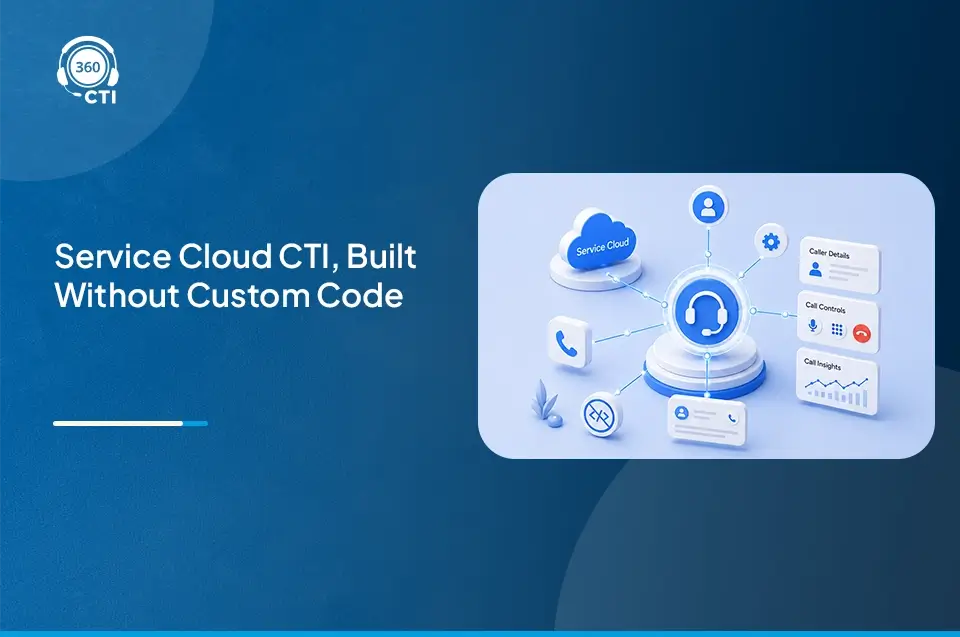
And the gap for most organizations is native Salesforce CTI experience that brings telephony, context, and AI into one place.
In this blog post, we’ll talk about why Salesforce Service Cloud and CTI integration is non-negotiable and how it can help you deliver a stellar experience to the customers.
What Happens When Salesforce CTI Integration is Missing?
When telephony runs outside Salesforce, your service reps and customers have to operate in silos. Here are some disadvantages of a missing Salesforce CTI integration.
- Agents Lose Context During Calls: If a customer calls to follow up on an open case but the agent dealing with them has no idea who they are, what they purchased, or what happened in the last conversation. They scramble to find the right case, and the customer begins to get frustrated. This can result in longer calls, slower resolution, and dropping CSAT.
- Manual Logging = Manual Error: Every call becomes a 60-90 second data entry chore. Multiply that by 100 agents handling 50 calls a day, and you’re looking at hundreds of wasted agent-hours daily. And even after all that effort, notes are incomplete, inaccurate, or too vague to be useful for the next rep.
- Voice Insights Never Reach Salesforce: A phone call with a customer is full of data like sentiments, urgency, keywords, objections, and intent. But none of this is captured if your Salesforce CTI is not integrated. It simply means that supervisors cannot coach agents effectively, leaders cannot see trending customer problems, cases lack insights from real conversations, and automation can’t trigger based on what people say.
- Performance Data Becomes Scattered: If your Salesforce CTI is not connected, you cannot answer basic questions like, “Why did call handle time spike this week? Are agents adhering to scripts? Which case types consume the most support time? This is because half the data lives inside the telephony system, not Salesforce.
Why Salesforce Service Cloud Alone is Not Enough
Service Cloud is the best-in-class tool for case management, workflows, and knowledge. But it cannot complete the support experience without real-time telephony intelligence feeding it. Without a connected Salesforce CTI layer:
- Calls cannot trigger workflows
- Conversations cannot be analyzed
- Agents cannot work from a unified console
- Supervisors cannot support agents in real time
- Automation, AI, and case intelligence stay underutilized
Consequently, Service Cloud becomes a powerful engine limited by a missing fuel source. And that fuel is CTI.
What Salesforce CTI Integration Unlocks
A native Salesforce CTI integration makes call handling easier and changes the entire support experience. It pulls voice into the center of your service operations and gives agents what they have been missing for years, which is context, clarity, and control. Here’s what that looks like in practice.
1. Everything Agents Need, Finally in One Screen
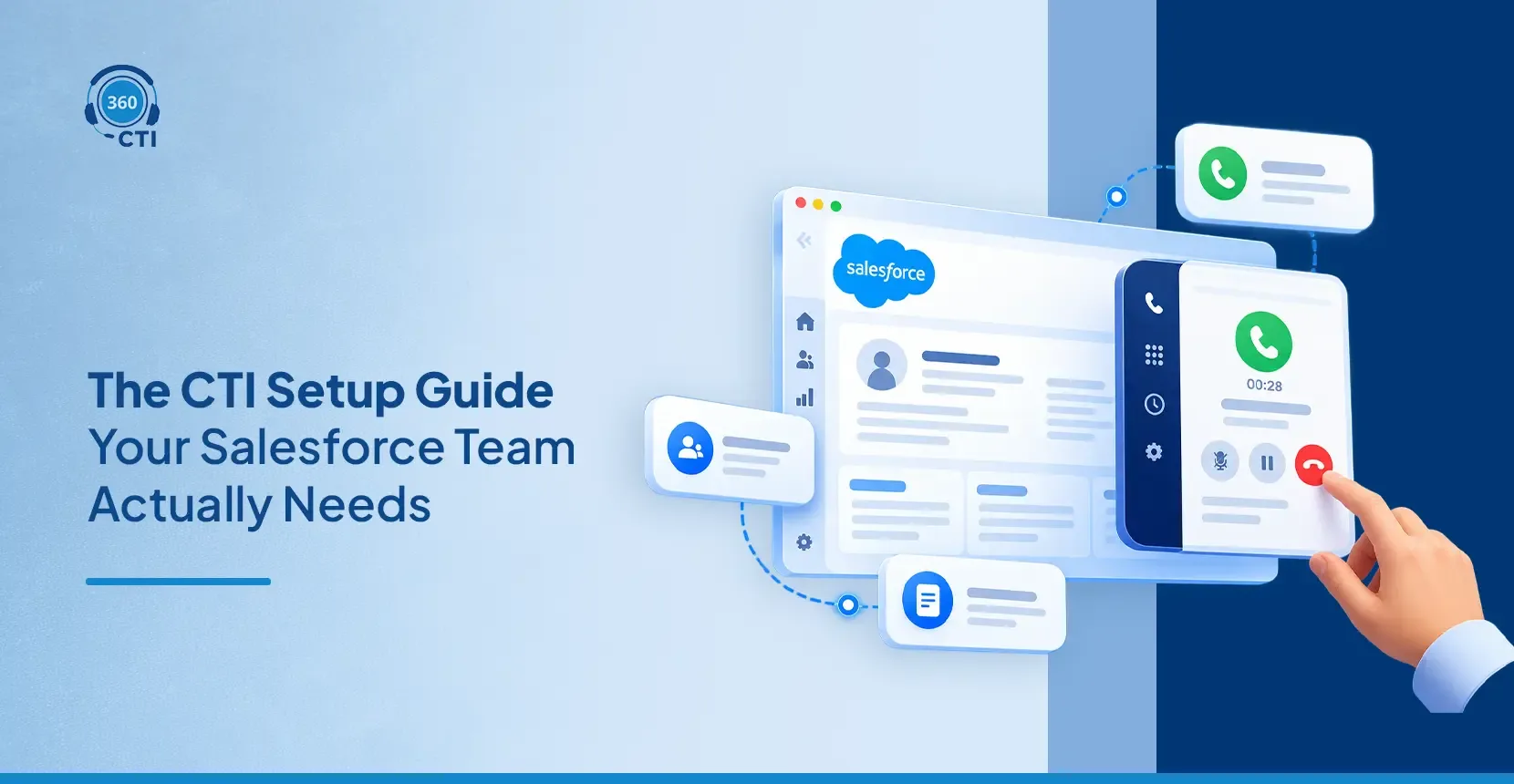
When you integrate Service Cloud and CTI, the constant switching between phone systems and Salesforce ends. Agents no longer have to search manually or guess who’s calling. With this integration, they get the full story – open cases, purchase history, entitlements, full interactions, and even sentiments from the previous conversations.
2. Real-Time, Personalized Conversations That Feel Effortless
Support is not transactional. It’s emotional. And customers always remember how a brand makes them feel. With CTI integrated into Salesforce, agents speak to customers as if they have been preparing for the call all morning. For instance, a customer is calling about a refund that is still pending. Before they say a word, the agent sees the refund request, approval status, and case notes. These moments matter, because they transform what could have been an average call into a personalized, meaningful interaction.
3. Auto Logging That Reclaims Thousands of Agent Hours
One of the main benefits of CTI is it removes repetitive, exhausting admin work that clogs up an agent’s day. Without CTI integration, a five-minute call often becomes a fifteen-minute follow-up task. Agents write notes, log activities, add disposition, update cases, and manually create tasks. This process is highly inefficient and incredibly prone to error. In a large support organization, auto-logging alone can reclaim hundreds to thousands of hours a month. And when you layer a Salesforce auto dialer on top, outbound service tasks like wellness check calls, SLA follow-up, or closure verification become a seamless, automated workflow that removes even more manual effort from the queue.
4. Smart Routing That Feels Like Magic for Customers
Routing is where CTI quietly saves the day. Customers don’t want to be bounced around. They want the person at the right moment. With Salesforce CTI integration, routing becomes both intelligent and dynamic. Rather than sending calls to whichever rep is free, the system evaluates skills, language, product expertise, customer tier, or even which agent handled the last conversation. For instance, a customer who previously spoke with ‘Shreya’ calls again. With sticky agent routing, the call goes straight to her if she is available. If Shreya is not available, the call goes to the next matching agent based on product expertise. These small things drastically improve first-call resolution and customer satisfaction.
5. Supervisor Tools That Turn Good Teams Into High-Performing Ones
Support leaders often feel disconnected from the live call experience. They don’t know which conversations are going well, which ones are going sideways, or where agents might need help in the moment. CTI integration changes that completely. With connected monitoring, supervisors can listen in on live calls, whisper guidance to agents without the customer hearing, or take over a call when needed. In addition to that, after the call, you can get AI-driven sentiment analysis, talk-time ratios, keyword flags, and call transcription. With this information, the supervisor can train with precision.
Conclusion
Service Cloud already handles cases, workflows, and digital channels beautifully, but the experience feels incomplete when the voice sits outside the system. A native Salesforce CTI integration brings everything together so every call carries the right context, logs itself automatically, and flows into the customer history smoothly. It creates faster resolution and more meaningful conversations powered by tools like the Salesforce auto-dialer. If your calls are still happening outside Salesforce, now is the time to bring them into the platform that shapes the rest of your customer experience.