Inbound and Outbound Calling in Salesforce: What Most Teams Get Wrong 

Diksha Gathania

18 May 2026

How to Fix Salesforce Inbound and Outbound Calling Setup

Most teams that bring calling into Salesforce do not realize they have a problem until one shows up. An inbound caller gets routed to an agent who is offline. A rep spends three minutes after every outbound call logging notes manually. A missed call sits in the phone system with no follow-up task in Salesforce. A new inbound lead never makes it into the CRM at all. 

These are not edge cases. They are the predictable result of setting up Salesforce inbound and outbound calling without a clear plan for each direction. This guide covers where each breaks down, what it costs, and how to fix it. For the full range of capabilities a Salesforce calling solution should cover, the 360 CTI feature overview is a useful starting point. 

How Salesforce Handles Inbound vs. Outbound Calling 

Salesforce does not treat phone calls as a built-in channel the way it handles email or tasks. Meaningful call workflows require a CTI integration built on the Open CTI framework, which surfaces a softphone inside Salesforce Lightning and connects it to live CRM data. Salesforce’s own phone integration considerations document outlines the core setup requirements teams should review before go-live. 

How Salesforce Handles Inbound vs. Outbound Calling

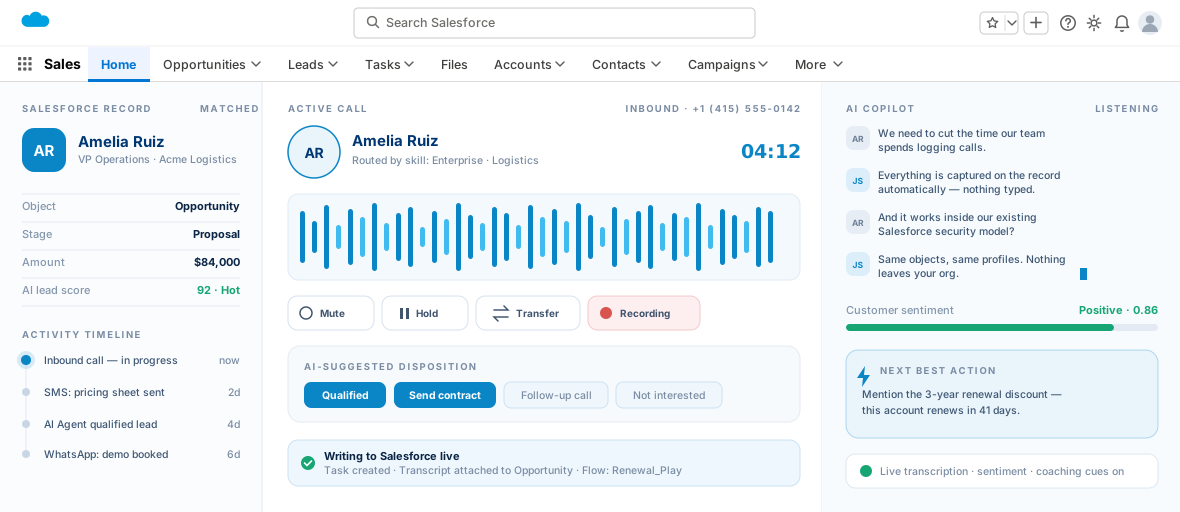
Inbound requires Salesforce to recognize the caller, surface the right record via screenPop() or searchAndScreenPop(), and route the call to an available agent. Every part of that chain depends on clean data and correctly configured routing rules. 

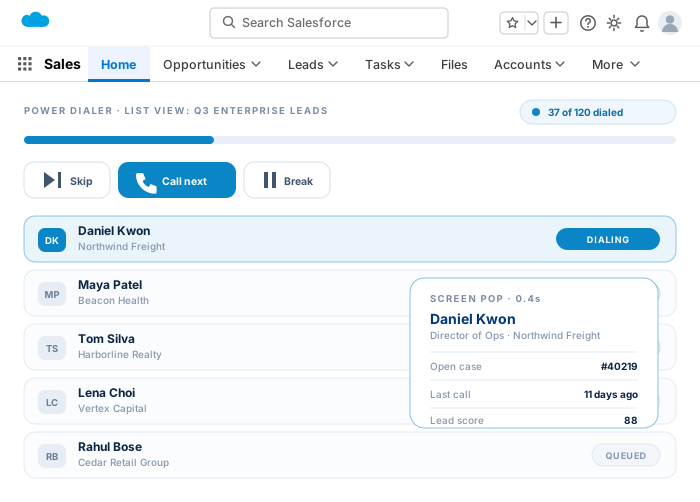
Outbound requires efficiency: click-to-dial from Salesforce records, automatic logging when the call ends via saveLog(), and a power dialer for high-volume lists. Where it breaks down is almost always in the logging and follow-up layer, not the dialing itself. 

The Most Common Inbound Calling Mistakes in Salesforce 

Inbound call handling in Salesforce depends on a chain of conditions — routing, record matching, and agent availability, all working together. When any one link breaks, callers either wait too long, reach the wrong person, or never get through at all. These are the four gaps that come up most consistently. 

  • Routing Rules That Ignore Agent Availability 

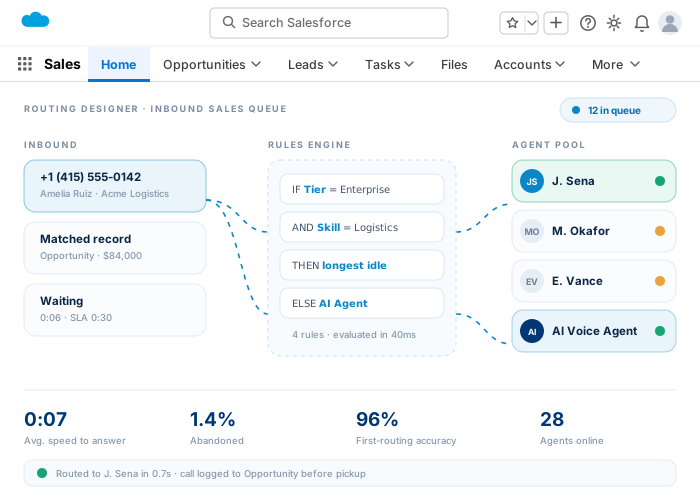
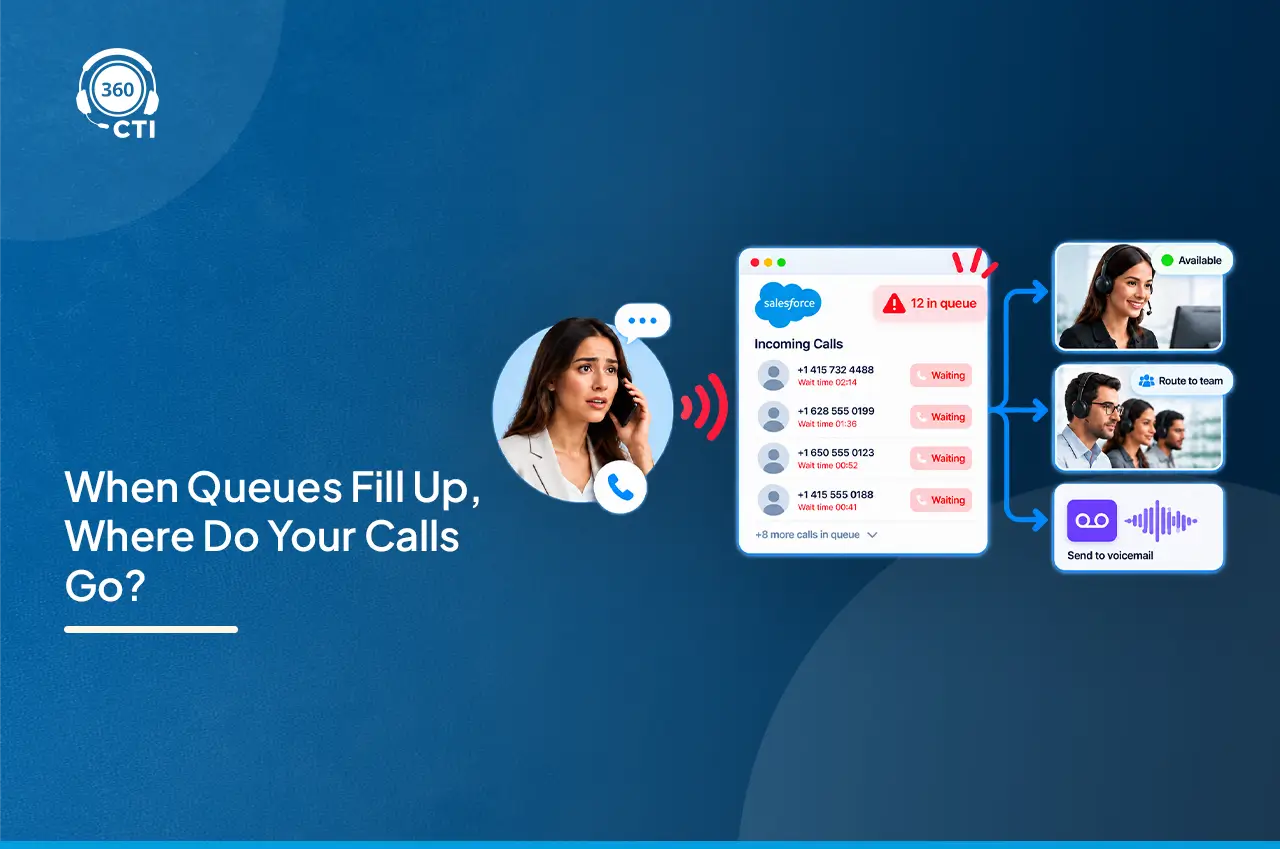
Most teams configure IVR menus and call queues at launch and never revisit them. Calls land on agents who are on break or logged out. A properly configured Salesforce call routing setup routes only to Online agents, uses business-hours logic for after-hours calls, and handles overflow with a voicemail or IVR self-service option rather than an unanswered ring. 

  • Screen Pop Failure from Inconsistent Phone Data 

Screen pop breaks when numbers are stored inconsistently across records. A number saved as (555) 123-4567 will not match a caller ID of +15551234567. The agent opens the call blind. The fix is a phone number format audit across all leads, contacts, and accounts before go-live. 

  • New Inbound Callers Falling Out of the CRM 

When a call arrives from an unrecognized number, most setups do nothing. A reliable inbound call handling setup automatically creates a lead record from that caller and attaches the call log as the first activity. Every inbound conversation should produce a visible CRM record. 

  • Missed Calls with No Follow-up Path 

Auto-forwarding to a mobile number gives a call a second chance when agents are away. A programmable voicemail on rejection keeps the caller experience intact when no one picks up. Every missed inbound call should also generate a follow-up task in Salesforce, so missed call tracking in Salesforce is visible to managers and reps alike. 

How to prevent your inbound calls slipping

The Most Common Outbound Calling Mistakes in Salesforce 

Outbound calling problems look different from inbound ones. The dialing part usually works. What breaks down is everything that happens around it — how lists are prepared, how calls are logged, and how outcomes are tracked. These are the four mistakes that quietly drain outbound productivity. 

  • Manual Logging After Every Call  

Post-call admin is the most consistent time sink in outbound operations. On 50 outbound calls a day, manually selecting a disposition, typing notes, and setting a follow-up task runs to roughly 2.5 hours per rep — every single day. The Open CTI saveLog() method writes call direction, timestamp, duration, outcome, and record association to Salesforce automatically the moment a call ends. Any CTI integration that leaves this to rep input is trading pipeline visibility for manual effort. 

  • Dispositions Too Complex to Use Consistently  

Even when logging is automatic, outcome tracking only works if reps actually complete the disposition field. Teams that build 15 outcome values end up with half their calls logged as “Other” or left blank. Sales teams need six options at most: Connected, No Answer, Voicemail, Interested, Not Interested, Follow-Up Needed. Fewer options mean higher completion rates and data that managers can actually build reports on. 

  • Unfiltered Call Lists with No DND Control  

Before a single outbound call is made, the list it is built from determines how productive that session will be. Dialing through a raw list that includes opted-out records, invalid numbers, and contacts already called three times that week wastes rep time and creates compliance exposure. Lists should be filtered using Salesforce call distribution list views before dialing begins. DND-opted records should auto-skip without requiring the rep to check manually. On international campaigns, auto country-code selection on redials prevents wrong-format dial failures that break the sequence. 

  • No Visibility Into What Salesforce Outbound Calling is Actually Producing 

Without reliable activity data, leaders cannot answer basic operational questions: How many calls went out? What was the connection rate? Which reps are hitting their numbers? When call data depends on manual input, those questions have no trustworthy answer. The Salesforce CTI integration guide covers how call activity objects connect to Salesforce reporting in detail. 

Inbound vs. Outbound Calling Gaps and Their Business Impact 

The table below maps each gap to its specific inbound and outbound impact so teams can prioritize what to fix first. 

Gap  Inbound Impact  Outbound Impact  
No agent availability controls  Calls land on offline agents; callers abandon  Inbound calls disrupt active outbound sessions  
Screen pop failure  Agents open calls with no caller context  Reps pull records manually before each dial  
New callers not captured  Inbound leads never enter the CRM  Lists contain invalid or incomplete numbers  
Manual call logging  Support history is incomplete across agents  Post-call admin cuts directly into calling time  
No missed call follow-up  Opportunity disappears with no action item  Unanswered attempts not tracked in Salesforce  
No DND management  Not applicable Compliance risk; wasted dial attempts on opted-out records  
No call recording  Cannot coach on real inbound conversations  No record of objections or commitments made on outbound calls  

What These Gaps Cost Your Team 

The business impact of broken inbound and outbound calling in Salesforce shows up directly in revenue, rep productivity, and reporting accuracy. 

  • Revenue: A missed inbound call without a same-day callback is often a missed deal or an expired renewal window. For salesforce contact center teams, unanswered calls during business hours represent direct revenue leakage, with no recovery path unless missed call tracking is active and generating visible follow-up tasks in Salesforce. 
  • Rep time: Across a 250-day work year, 2.5 hours of daily post-call admin per rep on a 10-person team adds up to over 6,000 hours of selling time consumed entirely by work that automatic call logging eliminates. That is capacity that could go toward pipeline coverage instead. 
  • Data quality: When call data is manually entered, inconsistently logged, or split between a phone system and the CRM, pipeline forecasts become unreliable and coaching decisions become guesswork. The longer the data problem goes unaddressed, the harder it is to reconstruct accurate activity history or identify what is actually driving conversion. 

How to Fix Inbound and Outbound Gaps Without Overhauling Your Stack 

Most of these problems do not require replacing your phone system. They require tighter workflow configuration and a CTI integration that enforces consistency on both sides. Here is where to start on each. 

Inbound fixes: 

  • Make agent availability status part of the start-of-shift process. Route inbound calls only to Online agents; configure Away and Offline to trigger overflow logic. 
  • Audit and standardize phone number formats across all leads, contacts, and accounts before enabling screen pop. 
  • Auto-create a Salesforce lead record for every inbound call from an unrecognized number, with the call log attached as the first activity. 
  • Enable auto-forwarding to mobile and programmable voicemail on rejection so no caller reaches a silent disconnect. 
  • Set missed call tracking to generate a follow-up task automatically, assigned to the right queue or agent inside Salesforce. 

Outbound fixes: 

  • Use automatic call logging so every completed call writes direction, timestamp, duration, outcome, and record association to Salesforce without rep input. 
  • Filter outbound lists in Salesforce list views before dialing. Auto-skip DND-opted records and exclude entries with missing phone data. 
  • Keep dispositions to six or fewer values and report on them weekly to track contact rate, connection rate, and outcome distribution by rep. 
  • Give reps Break and Skip controls during bulk dialing so they can pause mid-list without losing their place. 
fix both inbound and outbound calling in Salesforce

How 360 CTI Gives Teams a Unified Calling Experience in Salesforce 

360 CTI is a Salesforce-native CTI solution where every inbound and outbound call action feeds into the same CRM record, with no separate phone portal and no manual data sync.  

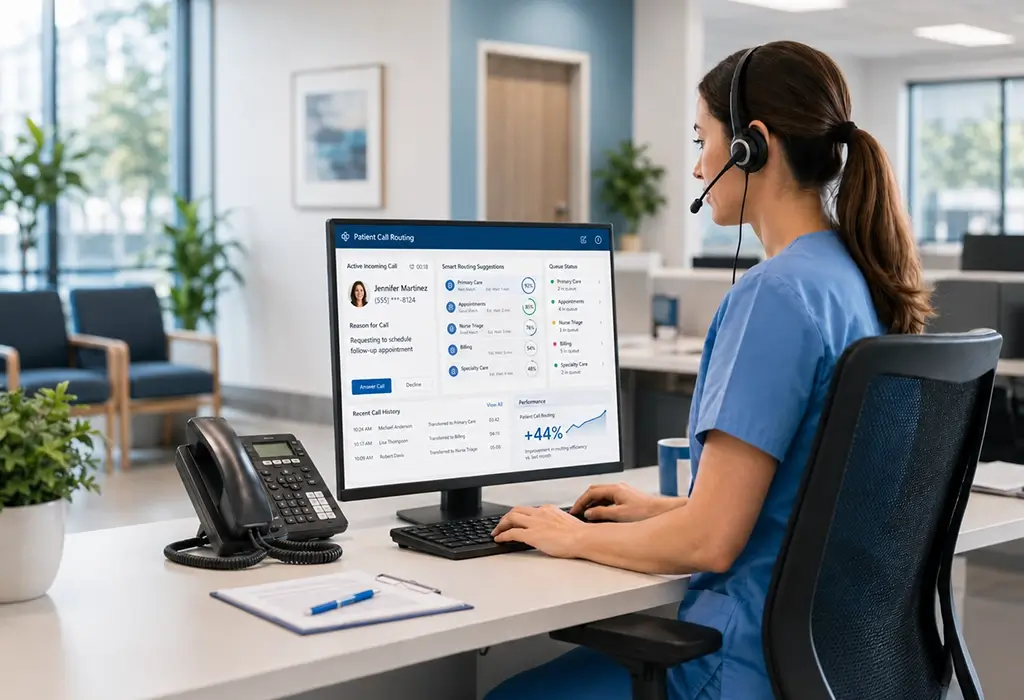
Inbound: When a call arrives, 360 CTI fires a screen pop for the matching Salesforce record or auto-creates a new lead for unrecognized callers. Routing is based on agent availability status, skill, team assignment, and business hours — all configured inside Salesforce. Agents set Online, Away, or Offline status directly in the softphone. Missed calls generate follow-up tasks automatically. Auto-forwarding reaches up to nine mobile numbers when agents are away from their desks. Programmable voicemail on rejection ensures no caller reaches a dead end. 

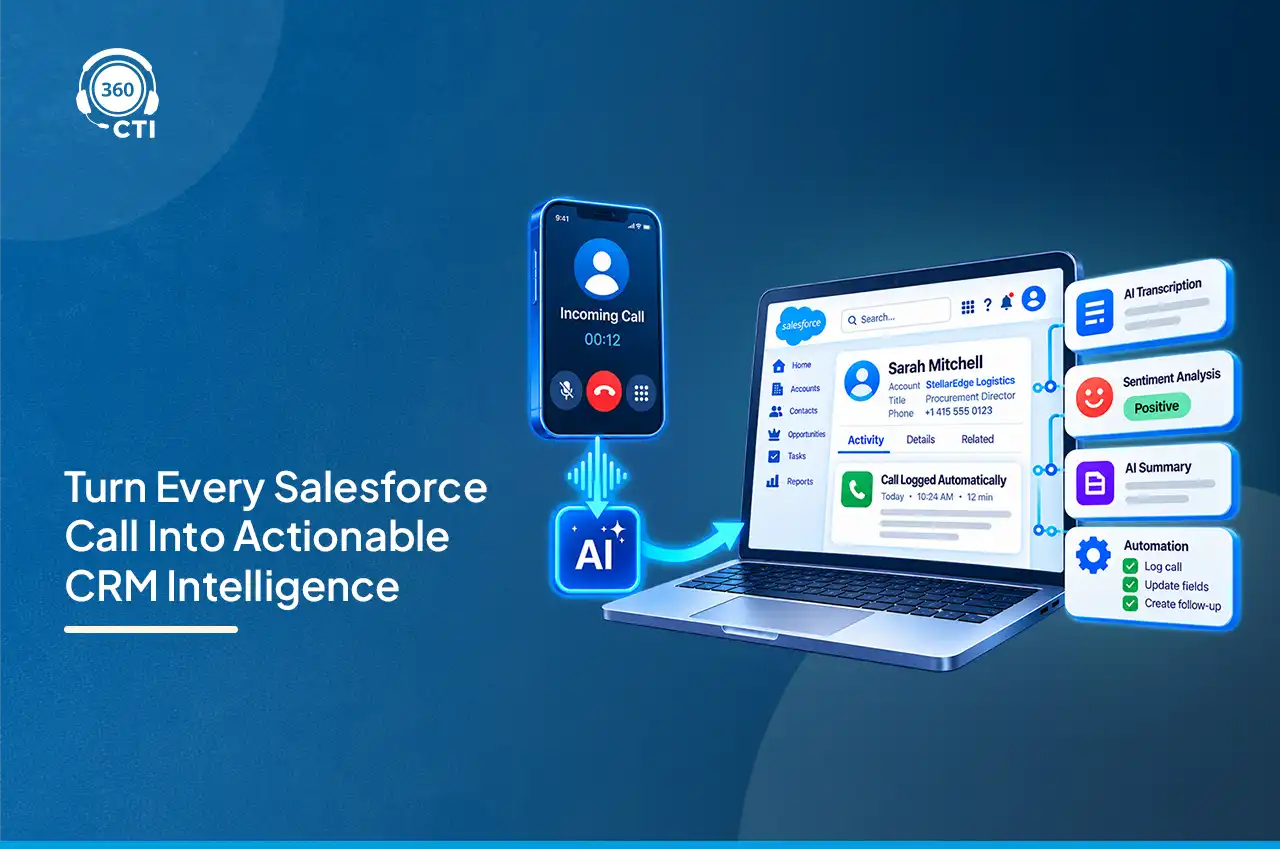
Outbound: For outbound teams, 360 CTI supports click-to-dial from any Salesforce record including leads, contacts, accounts, opportunities, and custom objects. The Power Dialer works through filtered call-down lists with a call queue approach, Break and Skip controls, automatic DND record skipping, and auto country-code selection on redials. Every completed call logs automatically via the Open CTI saveLog() method. Call recordings, real-time transcription, sentiment analysis, and AI-generated call summaries are all accessible directly from the Salesforce activity record. 

Reporting: All inbound and outbound call activity flows into standard Salesforce reporting objects. Call volume by direction, disposition distribution, missed call rate, connection rate, and agent availability patterns are all reportable inside Salesforce without exporting data to a separate analytics tool. 

Conclusion 

Salesforce inbound and outbound calling break for different reasons and require different fixes. Inbound fails when routing does not reflect operational reality and missed calls have no follow-up path. Outbound fails when logging depends on rep discipline and lists are not controlled before dialing begins. Every mistake covered in this guide is fixable without replacing your telephony infrastructure — and 360 CTI addresses both directions in one Salesforce-native integration, giving sales, service, and salesforce call center teams one place to manage calls, routing, logging, follow-ups, and reporting. 

FAQs

Inbound calling in Salesforce requires a CTI integration. When a call arrives, the Open CTI layer matches the caller's number against Salesforce records and fires a screen pop to open the relevant lead, contact, account, or case. The call routes to an available agent based on configured rules covering status, skill, team, and business hours. Without a CTI integration, Salesforce has no mechanism to recognize inbound callers, fire screen pops, or manage call queues automatically.

Inbound calling requires Salesforce to identify the caller, surface the right record, and route to the right agent before the conversation starts — the emphasis is on recognition, routing, and context. Outbound calling requires efficient dialing from records, automatic logging when calls end, and follow-up workflow management — the emphasis is on rep productivity and activity tracking. Both require CTI integration; the configuration priorities and failure points differ for each direction.

The most common mistake is configuring Salesforce call routing at setup and never revisiting it as team structure or shift patterns change. Calls end up routed to agents who are on break or reassigned. The second most common error is routing based on static queue membership without real-time availability status. A reliable setup routes only to Online agents and handles overflow with a voicemail, IVR self-service option, or scheduled callback.

Salesforce's native dialer supports basic outbound click-to-dial. It does not include multi-level IVR, skill-based routing, automatic screen pop, a power dialer, or automatic call logging. Teams running structured inbound or outbound call management need a CTI integration like 360 CTI to handle both directions properly inside Salesforce.

Reliable outbound call tracking in Salesforce starts with automatic logging. When a CTI integration writes call direction, duration, outcome, and rep to the correct Salesforce activity record on every call, managers can report on volume, connection rate, and disposition breakdown without relying on manual input — which is too inconsistent at scale to support accurate pipeline reporting.
Enjoyed the blog? Share it - your good deed for the day!

Recent Blogs

Inbound and Outbound Calling in Salesforce: What Most Teams Get Wrong 
CTI Tools 18 May 2026
Inbound and Outbound Calling in Salesforce: What Most Teams Get Wrong 

Most teams that bring calling into Salesforce do not realize they have a problem until one shows up. An inbound caller…

Diksha Gathania
Read More icon
Power Dialer in Salesforce: What High-Volume Sales Teams Should Look For
Compliance & Security 13 May 2026
Power Dialer in Salesforce: What High-Volume Sales Teams Should Look For

A sales rep opens Salesforce, copies a phone number, switches to a separate dialer, makes the call, switches back, types notes, logs…

Diksha Gathania
Read More icon
Salesforce Calling Solution: Features, Use Cases, and Setup Considerations 
Compliance & Security 08 May 2026
Salesforce Calling Solution: Features, Use Cases, and Setup Considerations 

A sales rep finishes a promising call, switches tabs, types notes from memory, logs the outcome, and sets a callback reminder in…

Diksha Gathania
Read More icon

FAQs

Inbound calling in Salesforce requires a CTI integration. When a call arrives, the Open CTI layer matches the caller's number against Salesforce records and fires a screen pop to open the relevant lead, contact, account, or case. The call routes to an available agent based on configured rules covering status, skill, team, and business hours. Without a CTI integration, Salesforce has no mechanism to recognize inbound callers, fire screen pops, or manage call queues automatically.

Inbound calling requires Salesforce to identify the caller, surface the right record, and route to the right agent before the conversation starts — the emphasis is on recognition, routing, and context. Outbound calling requires efficient dialing from records, automatic logging when calls end, and follow-up workflow management — the emphasis is on rep productivity and activity tracking. Both require CTI integration; the configuration priorities and failure points differ for each direction.

The most common mistake is configuring Salesforce call routing at setup and never revisiting it as team structure or shift patterns change. Calls end up routed to agents who are on break or reassigned. The second most common error is routing based on static queue membership without real-time availability status. A reliable setup routes only to Online agents and handles overflow with a voicemail, IVR self-service option, or scheduled callback.

Salesforce's native dialer supports basic outbound click-to-dial. It does not include multi-level IVR, skill-based routing, automatic screen pop, a power dialer, or automatic call logging. Teams running structured inbound or outbound call management need a CTI integration like 360 CTI to handle both directions properly inside Salesforce.

Reliable outbound call tracking in Salesforce starts with automatic logging. When a CTI integration writes call direction, duration, outcome, and rep to the correct Salesforce activity record on every call, managers can report on volume, connection rate, and disposition breakdown without relying on manual input — which is too inconsistent at scale to support accurate pipeline reporting.
WhatsApp Live Chat