
📋 BLOG SUMMARY
AI voice agents are now handling outbound prospecting, appointment reminders, and inbound inquiries for Salesforce teams at scale. However, every AI generated voice call falls under the TCPA’s rules on artificial and prerecorded calls, making AI voice agent compliance a legal requirement before the first dial goes out. From consent collection and disclosure to state level recording laws and Salesforce record keeping, Salesforce call compliance for AI calling programs requires considerably more than a standard dialer setup.
AI voice agents can now qualify leads, confirm appointments, and handle inbound inquiries at a scale no sales team can match manually. That capability comes with a compliance question most teams ask too late: are these calls actually legal?
The answer is yes, provided you follow the right rules. This guide walks through what the TCPA requires for AI voice agent compliance, the consent standards that apply before a call is made, disclosure obligations, state level recording laws, and how to structure your Salesforce environment so proof of consent is always traceable.
Do Compliance Rules Apply to AI Voice Agents?
They do, and the regulatory position on this is now explicit.
On February 2, 2024, the Federal Communications Commission (FCC) adopted a declaratory ruling, formally released February 8, 2024, known as FCC 24 17. The ruling clarified that AI generated voices used in phone calls qualify as “artificial or prerecorded voice” under the Telephone Consumer Protection Act (TCPA), 47 U.S.C. § 227. This applies regardless of whether a human monitors the call in real time.
The practical consequence: AI robocall rules that previously governed prerecorded messages now apply to any outbound call in which an AI voice agent speaks to the recipient. If your organization uses 360 CTI’s AI Voice Agent to call leads or customers on mobile numbers, the TCPA framework applies to that program.
This matters because the TCPA has teeth. Violations are not just regulatory findings; they create private rights of action, meaning individuals can sue.
📌 DID YOU KNOW
Under 47 U.S.C. § 227(b)(3), each TCPA violation carries a statutory penalty of $500 per call, rising to $1,500 per call for willful or knowing violations. An AI voice agent capable of making thousands of calls per day means non compliance is not simply a legal risk. It is a financial one that can scale as fast as the calling program itself.
Consent: What You Need Before an AI Agent Calls
The consent standard under the TCPA depends on who you are calling and why.
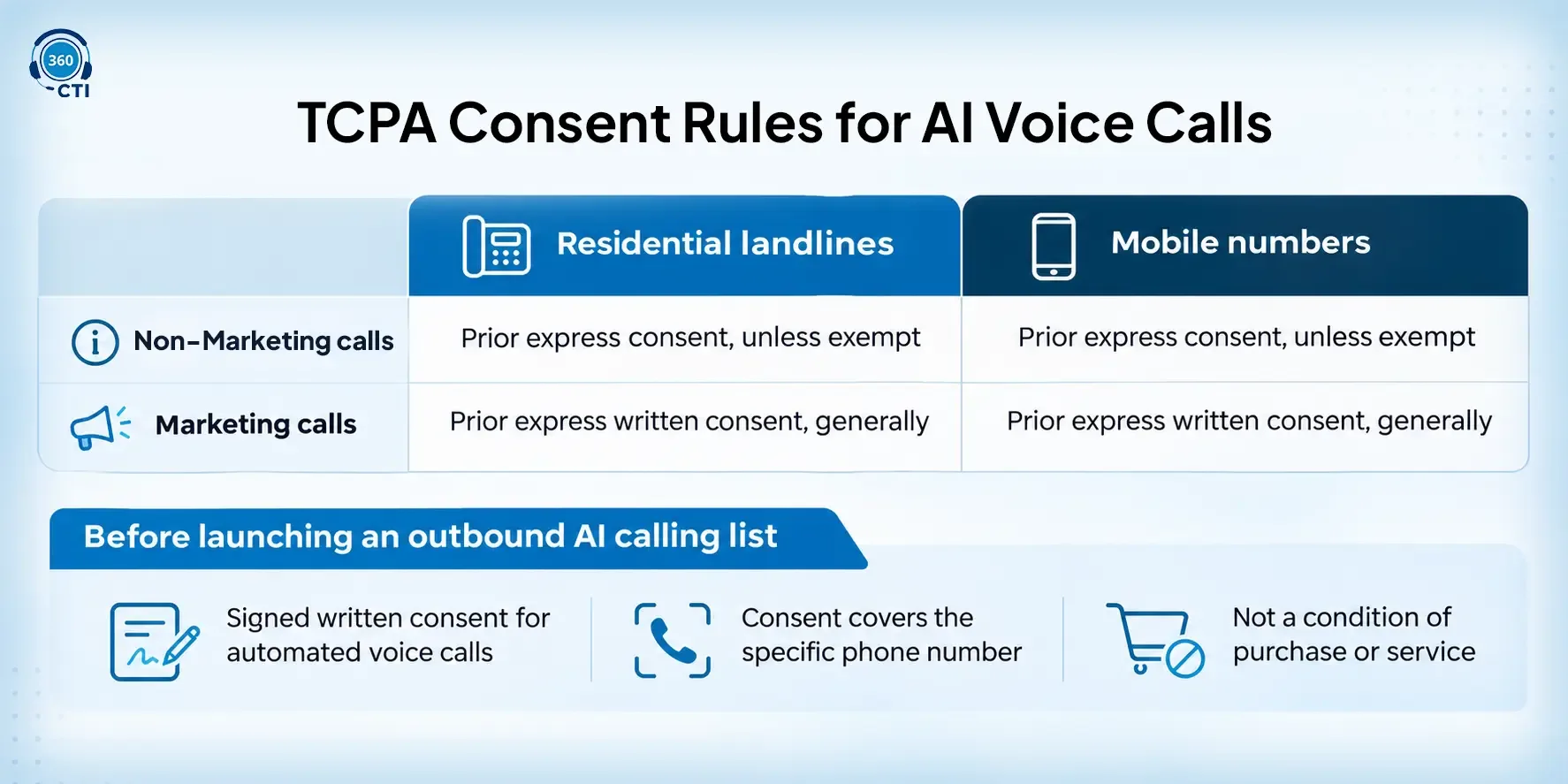
Calls to landlines using an artificial or prerecorded voice for non commercial or informational purposes require prior express consent. Marketing calls to landlines require prior express written consent.
Calls to mobile numbers using an automated telephone dialing system (ATDS) or an artificial/prerecorded voice require prior express consent for informational or non marketing calls, and prior express written consent for any call with a commercial or marketing purpose.
For most TCPA AI calls made as part of a sales or demand generation program, prior express written consent is the relevant standard. The FCC defines this as an agreement, in writing (which includes electronic records), bearing the signature of the person called, that clearly authorizes the caller to deliver AI voice calls, identifies the specific telephone number to which calls may be placed, and discloses that consent is not a condition of purchase.
For B2B calling, there is a commonly cited argument that calls placed to employees using business phone numbers fall outside TCPA scope. This is a nuanced legal position that varies by jurisdiction and by how the number is registered. Organizations relying on this argument should have it reviewed by legal counsel.
Three things to verify before activating any outbound AI calling list:
- Consent was collected in writing, with language that explicitly references AI or automated voice calls.
- The consent covers the specific phone number in the call record.
- Consent was not obtained as a condition of purchase or service.
Disclosure and Opt Out Requirements
Whether your AI voice agent is making outbound calls or handling inbound inquiries, two obligations apply consistently: disclosure and opt out.
Disclosure means informing the caller or called party that they are interacting with an AI, not a human representative. This obligation exists under FCC rules and, in some states, under separate consumer protection statutes. The disclosure does not need to be lengthy. A brief statement at the start of the call, for example, “Hi, this is an automated calling system from [Company Name],” satisfies the basic requirement and sets appropriate expectations for the conversation.
Opt out means giving the recipient a clear, simple, and functional way to end the call and request no further contact. The mechanism should work during the call, not just via email or a web form after the fact. When a contact opts out, that preference must be honored immediately and recorded in Salesforce against the relevant Lead, Contact, or Account record so the calling list is updated before the next campaign runs.
Teams using 360 CTI’s AI call monitoring capability can review AI call recordings to verify disclosure language is being delivered correctly and that opt outs are being captured as expected.
Call Recording Consent by State
Call recording adds another layer to AI call recording consent requirements, because the standard is not uniform across the United States.
- Federal law (one party consent): Under the Electronic Communications Privacy Act, only one party to a call needs to consent to recording. If your organization is recording the call, you are that consenting party. This federal floor applies in states that have not enacted stricter legislation.
- All party (two party) consent states: A significant number of states require all parties to a call to actively consent before recording begins. California, Connecticut, Florida, Illinois, Maryland, Massachusetts, Michigan, Montana, Nevada, New Hampshire, Oregon, Pennsylvania, and Washington are among the states with all party consent requirements, though the specifics of each state’s law vary. If your AI calling program reaches contacts in these states, the agent must announce that the call is being recorded at the outset, before substantive conversation begins.
The safest operational approach is to use an all party consent disclosure for every recorded call regardless of the recipient’s state. This eliminates the need to maintain a state by state calling configuration and reduces the risk of a recording being made in a two party state without proper notice.
For a detailed breakdown of what Salesforce captures, where it stores recordings, and how to manage retention, see this guide.
Inbound vs Outbound AI Calls: What Changes
The consent analysis differs depending on call direction, and understanding this distinction matters for how you configure your AI voice agent program.
Outbound AI calls carry the full weight of TCPA consent requirements described above. The organization initiating the call bears the burden of establishing that prior express written consent exists for each called number.
Inbound AI calls present a different situation. When a contact dials your number and an AI voice agent handles the interaction, the act of calling can itself constitute consent to an automated interaction, depending on how the inbound flow is structured and disclosed. For example, an IVR that announces automated handling before the AI engages is on stronger ground than one that presents the AI without notice.
Recording consent still applies on inbound calls in all party states. A contact calling your support line in California still needs to hear a recording disclosure before the interaction is recorded.
Regardless of direction, calls that touch Protected Health Information (PHI) or regulated financial data trigger additional obligations covered in the next section.
Industry Rules: Healthcare and Financial Services
Two industries carry additional Salesforce call compliance requirements that layer on top of TCPA obligations.
Healthcare: Any AI voice agent interaction that involves PHI, such as appointment reminders that reference a patient’s condition, prescription status, or clinical history, is subject to HIPAA. This means the technology handling the call must operate under a signed Business Associate Agreement (BAA), and PHI communicated during the call must be handled with appropriate safeguards in the healthcare industry.
Running patient calls through Salesforce?
See what safeguards healthcare teams need in place before going live.
Read the Guide →Financial services: Organizations operating under FINRA or SEC oversight have call recording retention obligations that go beyond TCPA. FINRA Rule 4511, for instance, requires broker dealers to retain records of business communications, which includes AI assisted calls, for a minimum of three years. State insurance and lending regulations may impose additional restrictions on automated outreach. Organizations in the financial industry should confirm their AI calling configuration against applicable FINRA and state level requirements.
How to Keep Proof of Consent in Salesforce
Proof of consent is not useful if it cannot be found when you need it. Structuring your Salesforce environment to capture and surface consent records reliably is as important as collecting them.
Store consent at the Contact or Lead level. Use a custom field or a consent management field set to record the consent type (express written, inferred, or none), the date consent was obtained, the channel through which it was collected (web form, email reply, manual entry), and the specific phone number to which consent applies.
Log the consent source document. Where consent was collected via a web form or signed document, store a reference to that record on the Salesforce object. This may be a Salesforce File, a link to a document storage record, or a form ID from a marketing automation platform.
Use call logs to establish the disclosure timeline. 360 CTI automatically logs call records in Salesforce including timestamps, duration, and disposition. When the AI agent delivers a disclosure at the start of a call, that timestamp in the call log helps establish that the disclosure was made before substantive conversation began.
Respect opt outs immediately. When a contact opts out during an AI call, the disposition should trigger a Salesforce workflow that updates the contact’s communication preference field and removes them from active calling queues. Automation that depends on a manual update to take effect creates an operational gap that can produce additional calls to opted out contacts.
Audit the consent data before each campaign. Run a report that surfaces contacts without a valid consent record or with an opt out status before exporting any calling list. This step takes minutes and is far less costly than the alternative.
Want to understand how faster follow up connects to pipeline outcomes?
Read this blog →AI Voice Agent Compliance Checklist
Use this checklist before activating any AI calling program in Salesforce.
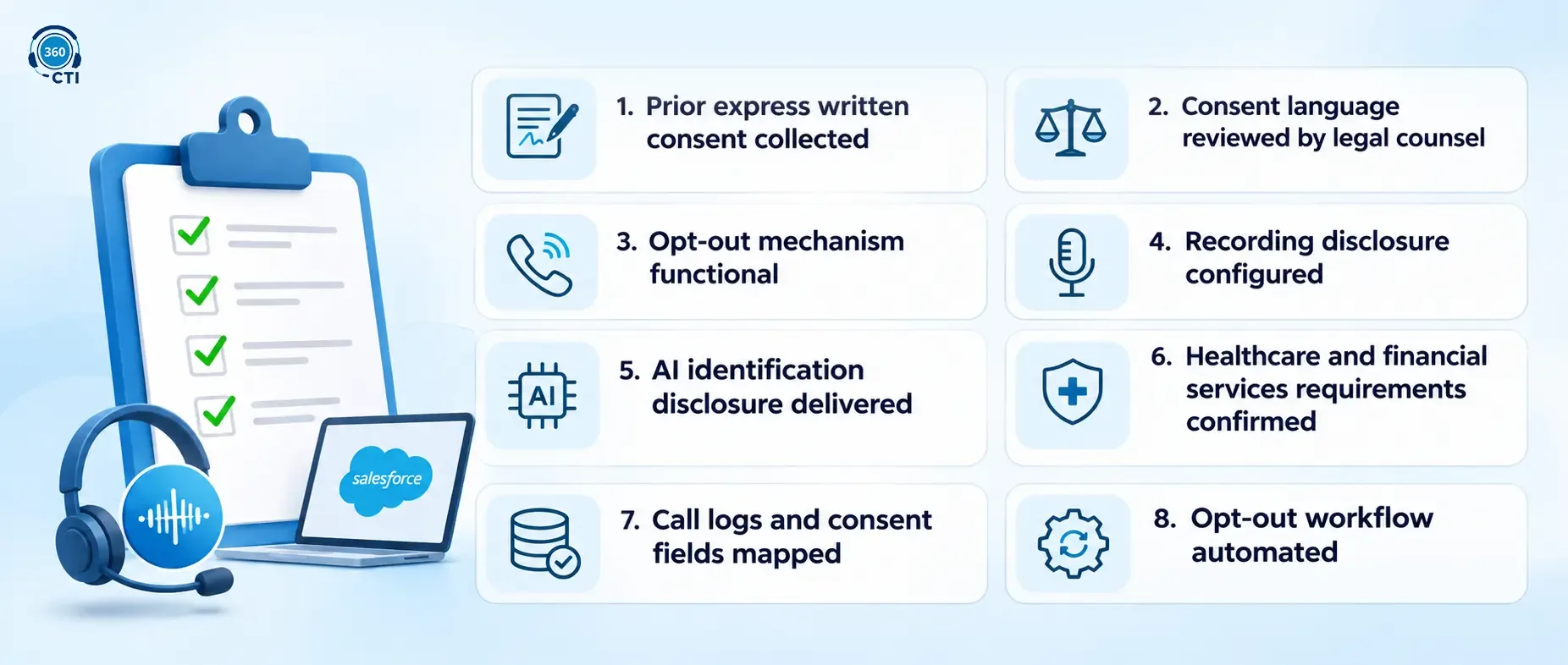
- ✓Prior express written consent collected for every mobile number in the outbound calling list, with documentation stored in Salesforce.
- ✓Consent language reviewed by legal counsel to confirm it explicitly authorizes AI or automated voice calls.
- ✓Opt out mechanism functional within the AI call flow and tested before the campaign goes live.
- ✓Recording disclosure configured as the first spoken line on every recorded call, using all party language for contacts in any jurisdiction.
- ✓AI identification disclosure delivered at the start of each call so contacts know they are speaking with an automated system.
- ✓Healthcare and financial services BAA or regulatory requirements confirmed if the calling program touches regulated data.
- ✓Call logs and consent fields mapped in Salesforce so both are accessible on the Contact or Lead record.
- ✓Opt out workflow automated so consent preference updates take effect before the next campaign run.
Conclusion
An AI calling program that runs at scale but collapses under a compliance review is not an asset. It is a liability that compounds with every dial. Getting the consent framework right, building Salesforce to hold proof of that consent, and ensuring the AI agent identifies itself correctly on every call are not obstacles to launching the program. They are what makes the program defensible when it matters.
None of this requires slowing down. It requires doing the setup once, correctly. Organizations that treat compliance as part of the technical configuration, not an afterthought reviewed after the first campaign, run their AI calling programs with considerably more confidence, because every call, consent record, and opt out is traceable the moment it needs to be.