
📋 BLOG SUMMARY
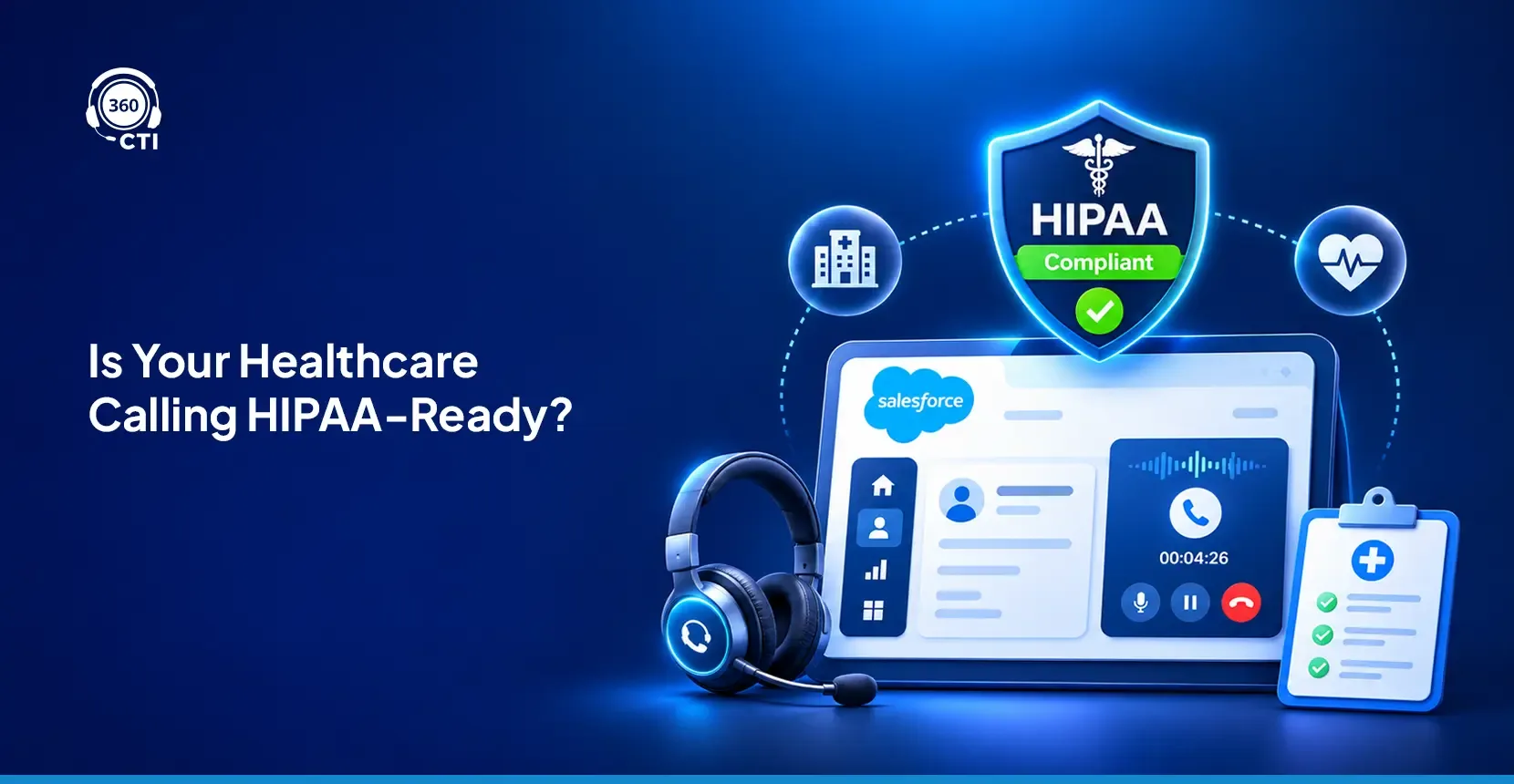
Salesforce CTI for hospitals helps healthcare teams manage patient calls, appointments, and follow-ups within Salesforce. However, healthcare conversations often involve protected health information (PHI), making HIPAA compliance essential. From secure call recording to role-based access and patient data visibility, Salesforce CTI for healthcare requires safeguards beyond basic telephony.
A patient calls to reschedule an appointment. The receptionist opens their Salesforce record, checks the appointment history, and transfers the call to the appropriate department.
Simple enough. But what happens to the information exchanged during that call?
If the conversation includes medical history, treatment details, or insurance information, the healthcare organization must ensure the data is handled according to HIPAA requirements.
This is where choosing Salesforce CTI for healthcare becomes more complicated than selecting a standard business calling solution.
Healthcare organizations need more than click-to-dial, automated logging, and intelligent routing. They need controls over who accesses patient information, how conversations are recorded, where sensitive data is stored, and how system activity is audited.
The challenge isn't simply connecting telephony with Salesforce. It's ensuring that every interaction supports patient confidentiality without slowing down care coordination.
For hospitals, clinics, and healthcare contact centers, that distinction matters.
Four HIPAA Requirements That Directly Affect Salesforce Calling Setups
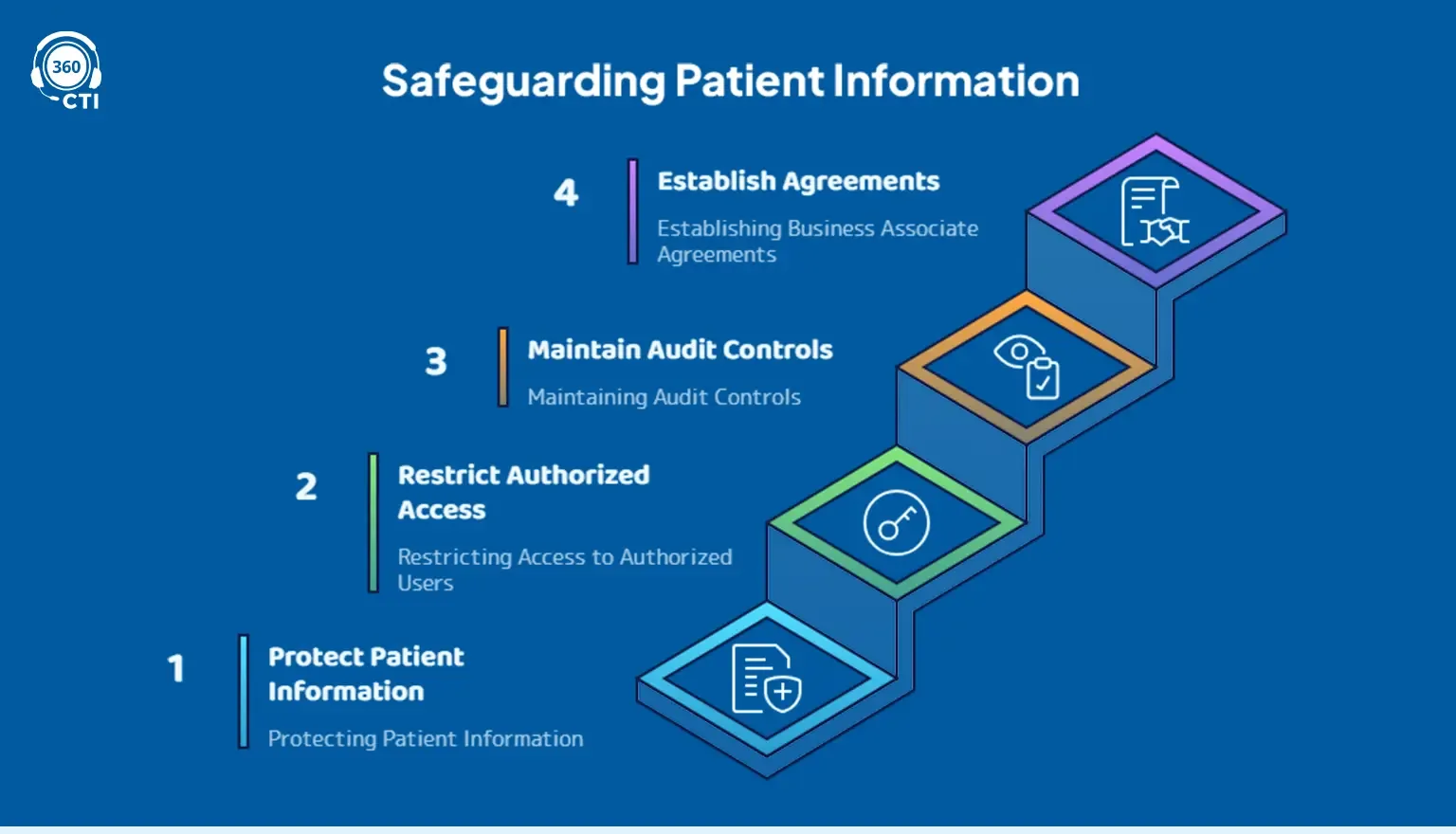
The Health Insurance Portability and Accountability Act (HIPAA) establishes requirements for protecting patient information. When healthcare organizations integrate calling platforms with Salesforce, four areas deserve particular attention.
1. Protecting Patient Information
Patient calls may reveal names, diagnoses, prescriptions, insurance details, or appointment information. When this data identifies an individual and relates to their healthcare, it can constitute PHI.
Your Salesforce healthcare telephony setup must protect information captured in call logs, recordings, transcripts, and related CRM records.
That means evaluating data storage, transmission security, access permissions, and how information moves between Salesforce and telephony providers.
2. Restricting Access to Authorized Users
Not every employee requires access to every patient conversation.
A scheduling representative may need appointment details, while a billing specialist requires payment information. Neither necessarily needs unrestricted access to clinical records.
HIPAA's minimum necessary principle generally requires organizations to limit appropriate uses, disclosures, and requests for PHI. Certain exceptions apply, including disclosures to healthcare providers for treatment.
Role-based permissions should reflect those distinctions.
3. Maintaining Audit Controls
Healthcare organizations must be able to examine relevant system activity involving electronic PHI.
For Salesforce CTI for hospitals, this means considering how call-related access, record changes, recording retrieval, and administrative actions are logged and reviewed.
The HIPAA Security Rule requires mechanisms to record and examine activity in systems containing electronic PHI.
4. Establishing Business Associate Agreements
If a telephony provider creates, receives, maintains, or transmits PHI on behalf of a covered healthcare organization, it may qualify as a business associate.
In applicable cases, a Business Associate Agreement (BAA) is necessary before PHI is shared.
This requirement can extend to recording storage providers, transcription services, and other subcontractors handling patient information.
📌 DID YOU KNOW
HIPAA does not require healthcare organizations to record patient calls. However, recordings that contain PHI must be appropriately protected when retained. The HIPAA Security Rule's six-year documentation retention requirement also does not automatically mean every patient call recording must be stored for six years.
HIPAA Call Recording: What Healthcare Teams Must Protect
Call recording is valuable for training, dispute resolution, and service quality. But recording patient conversations introduces additional privacy responsibilities.
A Salesforce calling solution healthcare teams adopt should give administrators control over recording workflows.
What Should Be Masked or Restricted?
Sensitive information such as payment card details, patient identifiers, and medical information should not be unnecessarily exposed.
Healthcare teams should evaluate whether their system supports:
- Pausing or disabling recordings during sensitive conversations.
- Restricting playback to authorized personnel.
- Masking sensitive identifiers where appropriate.
- Preventing unauthorized recording downloads.
- Applying defined retention and deletion policies.
HIPAA does not universally require masking every diagnosis or patient identifier. The appropriate controls depend on the information involved and the organization's risk assessment.
Healthcare providers must also consider applicable federal and state call-recording consent laws.
Automate Patient Calls Without Compromising Care.
Reduce manual calling tasks, streamline patient follow-ups with AI-powered Salesforce call automation.
Explore AI Call Automation →How Long Should Recordings Be Retained?
There is no universal HIPAA rule requiring all patient phone recordings to be retained for six years.
Healthcare organizations should establish retention schedules based on applicable legal requirements, clinical record policies, contractual obligations, and business needs.
Recordings maintained as part of a designated record set may also trigger patient access obligations.
The right approach is to determine what should be recorded, why it is retained, who can retrieve it, and when it should be securely deleted.
Patient Data in Salesforce Screen Pops: What Should Appear?
Screen pops are among the most useful features of Salesforce CTI for healthcare. When patients call, Salesforce can display relevant information before the representative answers.
But displaying more patient data doesn't automatically improve service.
Consider a patient calling about an appointment. The representative may need the patient's name, contact details, appointment time, and assigned department.
Displaying unrelated diagnoses, treatment notes, or sensitive medical history could create unnecessary exposure.
What Should Appear?
Depending on the representative's responsibilities, appropriate information may include:
- Patient name and verified contact details.
- Appointment status and scheduling information.
- Assigned department or care coordinator.
- Relevant service cases and previous interactions.
What Should Remain Restricted?
Clinical records, sensitive diagnoses, treatment information, and detailed insurance data should be accessible only when justified by the employee's role and applicable HIPAA rules.
Healthcare teams should configure screen pops using Salesforce object permissions, field-level security, and record-sharing controls.
The objective is straightforward: provide enough context to resolve the caller's request without exposing unrelated patient information.
A properly designed screen pop reduces repeated questions while maintaining access boundaries.
Access Controls: Who Can Listen to Healthcare Calls?
One of the biggest risks in healthcare telephony is uncontrolled access to recordings and transcripts.
Consider a hospital contact center where supervisors review calls for quality assurance. That doesn't automatically justify giving every supervisor access to sensitive clinical conversations.
Access should align with documented responsibilities.
Healthcare teams should evaluate three permission levels:
- Frontline representatives: Access to assigned patient interactions and the information necessary to perform their duties.
- Supervisors: Access to authorized recordings, monitoring tools, and quality-related information within their responsibilities.
- Compliance administrators: Access to relevant audit records, security investigations, and approved compliance workflows.
Healthcare organizations should also implement appropriate authentication, access reviews, and procedures for removing permissions when employees change roles.
The same considerations apply to AI-generated transcripts and call summaries.
For organizations evaluating these capabilities, 360 CTI's AI Call Monitoring provides live monitoring, supervisor assistance, and call-review functionality that can be incorporated into controlled healthcare workflows.
However, monitoring permissions and PHI access restrictions must be validated during implementation.
How 360 CTI Supports Healthcare Calling Inside Salesforce
A healthcare calling platform should connect communication workflows with CRM data without creating unnecessary administrative complexity.
360 CTI offers Salesforce-native calling capabilities that healthcare organizations can configure around operational and security requirements.
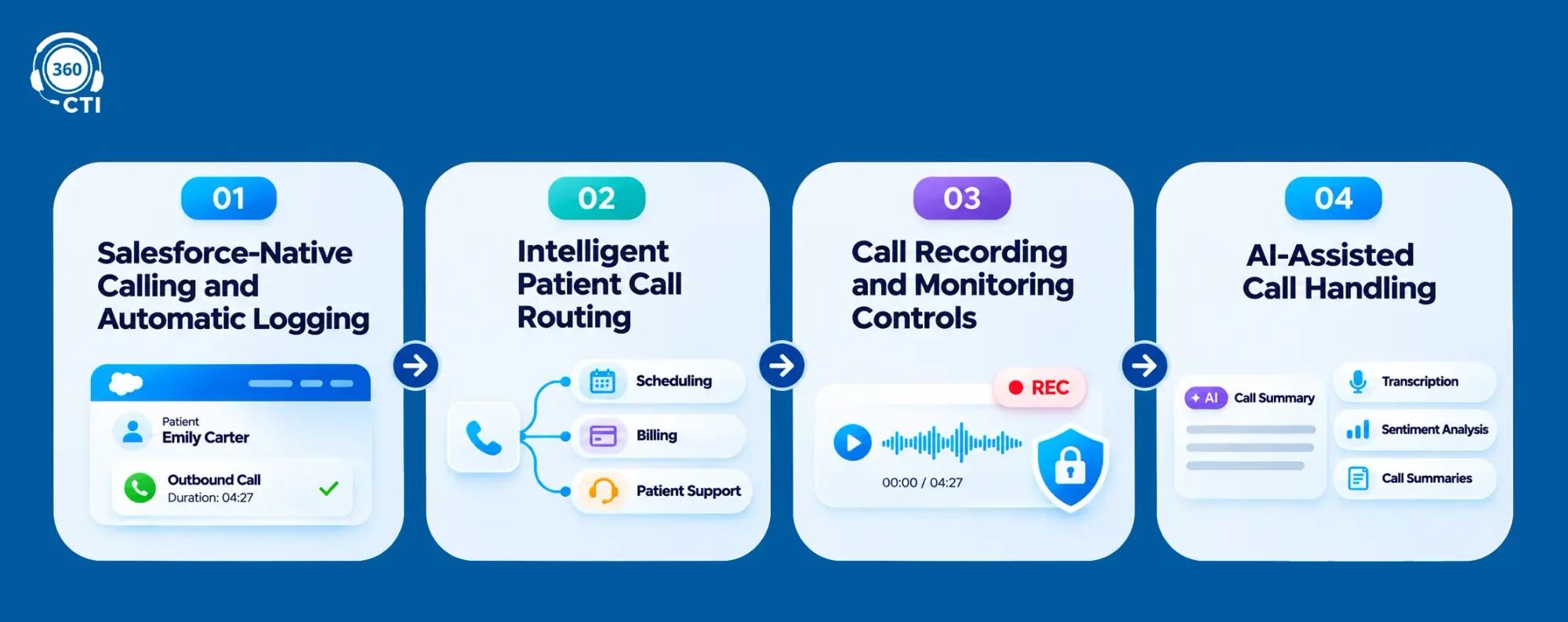
1. Salesforce-Native Calling and Automatic Logging
360 CTI connects inbound and outbound calls with Salesforce records, helping teams capture call durations, outcomes, and follow-up activity.
Its Salesforce Calling Solution supports click-to-dial, call management, and automatic activity logging.
Healthcare administrators should configure which information appears in call records and verify that PHI access follows approved Salesforce permissions.
2. Intelligent Patient Call Routing
Hospitals regularly handle appointments, billing inquiries, urgent requests, and general patient support.
360 CTI's routing capabilities help direct callers to appropriate teams based on configured rules, availability, and relevant CRM context.
For example, an appointment inquiry can reach scheduling rather than moving through multiple departments.
Explore how Salesforce AI Call Routing supports more structured inbound calling workflows.
Clinical emergencies still require separate, clearly defined escalation procedures.
3. Call Recording and Monitoring Controls
360 CTI supports call recording, monitoring, consent-related workflows, and number masking.
These capabilities can help organizations establish controlled processes for reviewing conversations and protecting contact information.
Before deployment, healthcare teams should verify recording storage locations, encryption arrangements, playback permissions, retention options, and the availability of audit evidence.
Number masking alone does not make recorded PHI HIPAA-compliant.
4. AI-Assisted Call Handling
AI-powered transcription, sentiment analysis, and call summaries can reduce documentation effort and improve follow-up visibility.
However, healthcare organizations must assess how AI providers process patient information, whether necessary BAAs are available, and how transcripts are stored or reused.
AI features should only process PHI within an appropriately approved and configured environment.
Healthcare Results: Why Better Call Routing Matters
HIPAA compliance and operational efficiency should not be competing priorities.
When patients repeatedly transfer between departments, healthcare organizations face longer resolution times, frustrated callers, and more opportunities for communication errors.
Intelligent routing addresses this by connecting callers with teams equipped to resolve their requests.
360 CTI's healthcare solution highlights operational outcomes, including up to 41% faster patient call resolutions and up to 35% fewer missed appointments.
These figures illustrate the potential value of better routing, automated reminders, and consistent follow-up processes. Actual results depend on the organization's implementation and operating environment.
For hospital leaders, the bigger lesson is that efficient patient communication depends on both the quality of the routing workflow and the safeguards surrounding patient data.
A faster call isn't necessarily a better call if sensitive information reaches the wrong person.
What Healthcare Teams Should Check Before Selecting Salesforce CTI
Before investing in Salesforce CTI for hospitals, healthcare organizations should evaluate the entire communication environment rather than focusing only on calling features.
Start with the data flow.
Where do recordings go? Which provider processes transcripts? Who can access stored conversations? How does patient information move between Salesforce and external systems?
Next, examine the contractual requirements.
Determine which vendors and subcontractors qualify as business associates and whether the necessary agreements are available.
Then validate the technical safeguards.
Test user permissions, recording access, audit logging, retention policies, and secure transmission. Review how the solution behaves when a user changes roles or leaves the organization.
Finally, evaluate real patient workflows.
A scheduling representative, billing agent, nurse, and compliance officer should not necessarily see identical information.
The strongest healthcare telephony architecture is one where the patient experience, Salesforce permissions, and privacy policies work together.
Conclusion
Healthcare communication is becoming more connected, but connectivity alone doesn't guarantee security.
Hospitals need calling systems that help teams respond faster while protecting sensitive patient information throughout every interaction.
That requires careful attention to recording policies, access controls, screen-pop visibility, audit logs, and vendor responsibilities.
A Salesforce CTI for healthcare solution can bring calling and CRM workflows together. The real value comes from implementing those capabilities within a well-governed security and compliance framework.
With Salesforce-native calling, intelligent routing, and automatic logging, 360 CTI gives healthcare teams a foundation for more coordinated patient communication.