
📋 BLOG SUMMARY
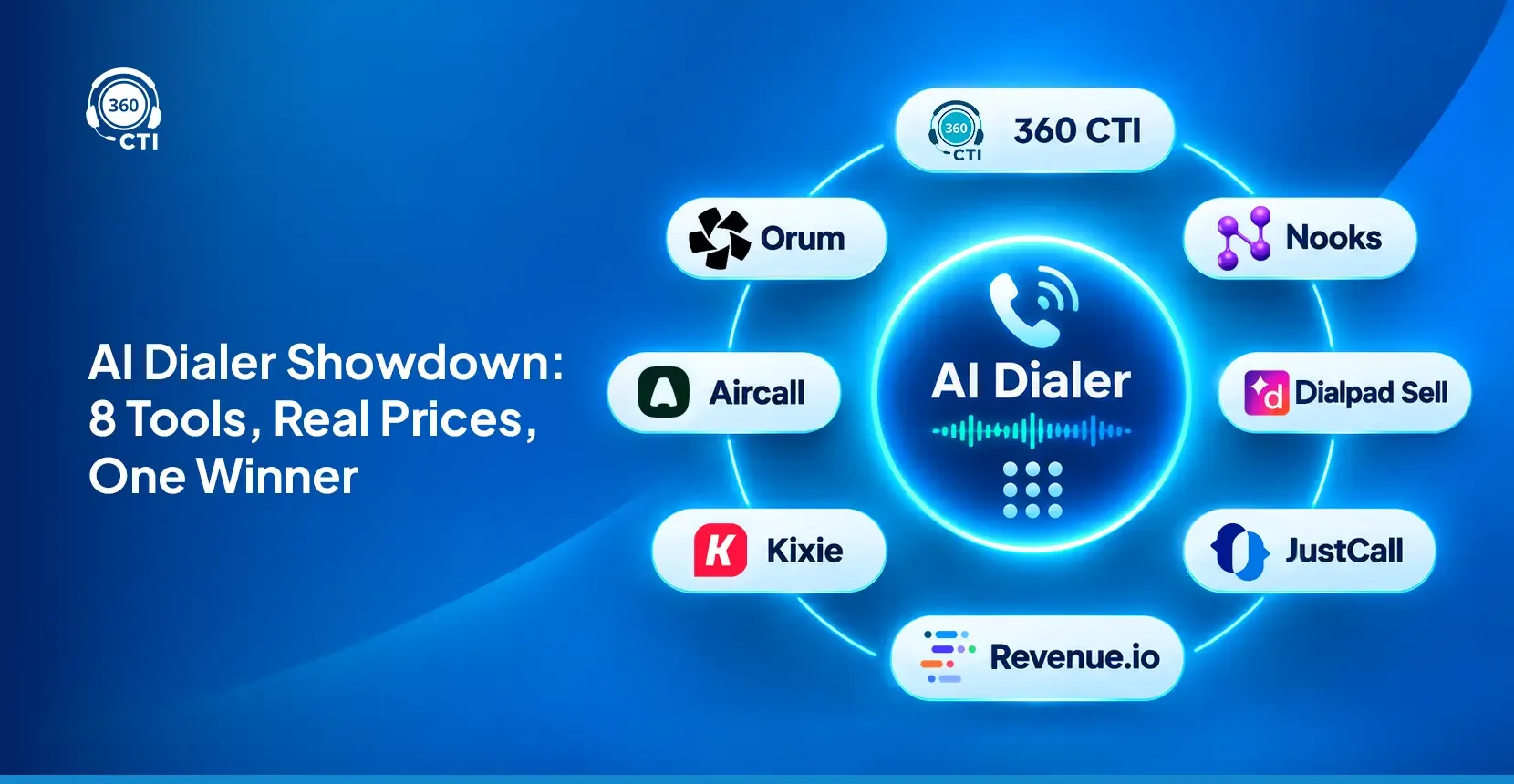
Choosing the right AI dialer for Salesforce in 2026 means knowing what "AI" actually covers — from post-call summaries to voice agents that run without a human on the line. This post breaks down 8 tools by Salesforce integration depth, AI maturity level, and actual cost, so you're comparing apples to apples before you sign anything.
Every dialer vendor calls itself an AI dialer for Salesforce now. The problem is that "AI" covers a spectrum from basic call transcription to fully autonomous voice agents, and vendors rarely tell you which level they've actually reached. That gap matters a lot when you're trying to match a tool to your team's workflow rather than a sales deck.
Before we get into the tools, it's worth anchoring on what that AI taxonomy actually looks like. Level 1 is AI after the call: summaries, transcription, CRM auto-logging. That's table stakes in 2026. Level 2 is AI during the call: real-time coaching prompts, battlecard surfacing, objection handling cues. Level 3 is AI before the call: lead prioritization scored on intent signals, predictive sequencing, next-best-action recommendations. Level 4 is AI making the call: autonomous voice agents that handle outbound prospecting without a human on the line.
All pricing in this post was verified directly from each vendor's website in November 2026. Where a vendor doesn't publish pricing, that's noted with "quote-based" rather than a third-party estimate.
What Makes a Dialer an "AI Dialer"?
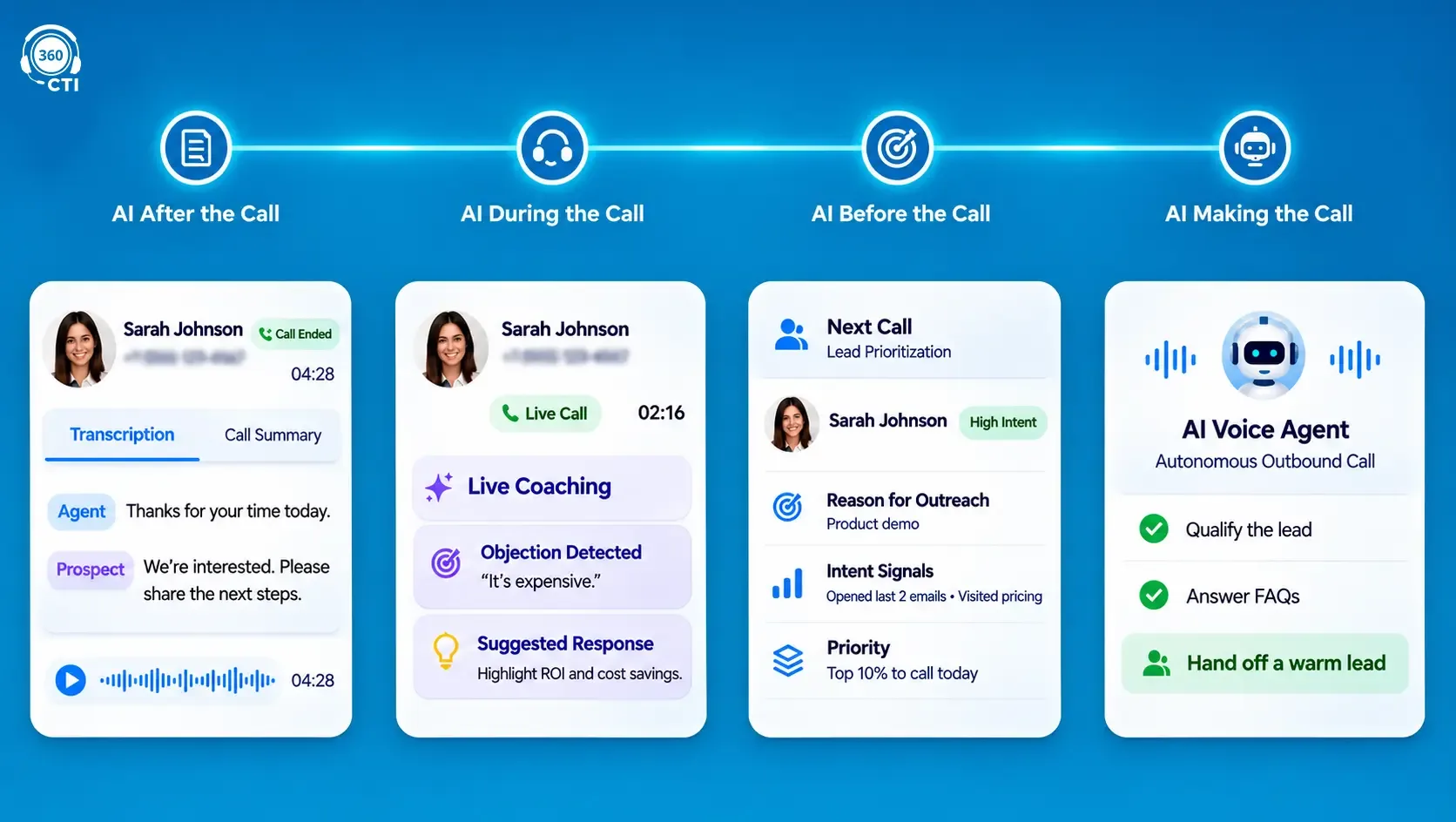
The honest answer is that most vendors have level 1 covered and are still building toward level 3. The distinction matters because a team buying for SDR efficiency wants something very different from a team buying to reduce headcount on outbound prospecting.
Level 1: AI After the Call
Transcription, call summaries, and auto-populated CRM fields. Every serious dialer on this list handles this. If a tool's AI features start and end here, it's doing compliance logging with a marketing upgrade.
Level 2: AI During the Call
Live coaching prompts, real-time battlecard surfacing, talk-track cues when a prospect raises a known objection. Dialpad and Revenue.io have invested heavily here. It's the most visible form of AI assistance because reps notice it immediately during calls.
Level 3: AI Before the Call
Intent data scoring, lead prioritization, predictive sequencing based on engagement signals. Orum and Nooks lean into this layer, feeding their parallel dialing engine with AI-ranked call lists so reps spend the most time on the conversations most likely to convert.
Level 4: AI Making the Call
Voice agents that conduct outbound calls autonomously, qualify leads, handle FAQs, and hand off warm prospects to human reps. Very few dialers built for Salesforce can reach this level, and few dialers built for Salesforce can match it natively without a separate AI voice platform bolted on the side.
How We Evaluated These AI Dialers
Three criteria drove the ranking: how deeply the tool integrates with Salesforce Lightning (native app versus third-party connector versus manual sync), what AI level it genuinely operates at beyond the marketing language, and whether pricing was publicly verifiable. Tools where pricing requires a sales call were noted but not penalized since that's standard enterprise practice, not a flaw.
We also flagged TCPA compliance implications for teams using Level 4 AI calling in US outbound, since the FCC's February 2024 ruling changed the consent requirements significantly. That gets its own section later in this post.
1. 360 CTI
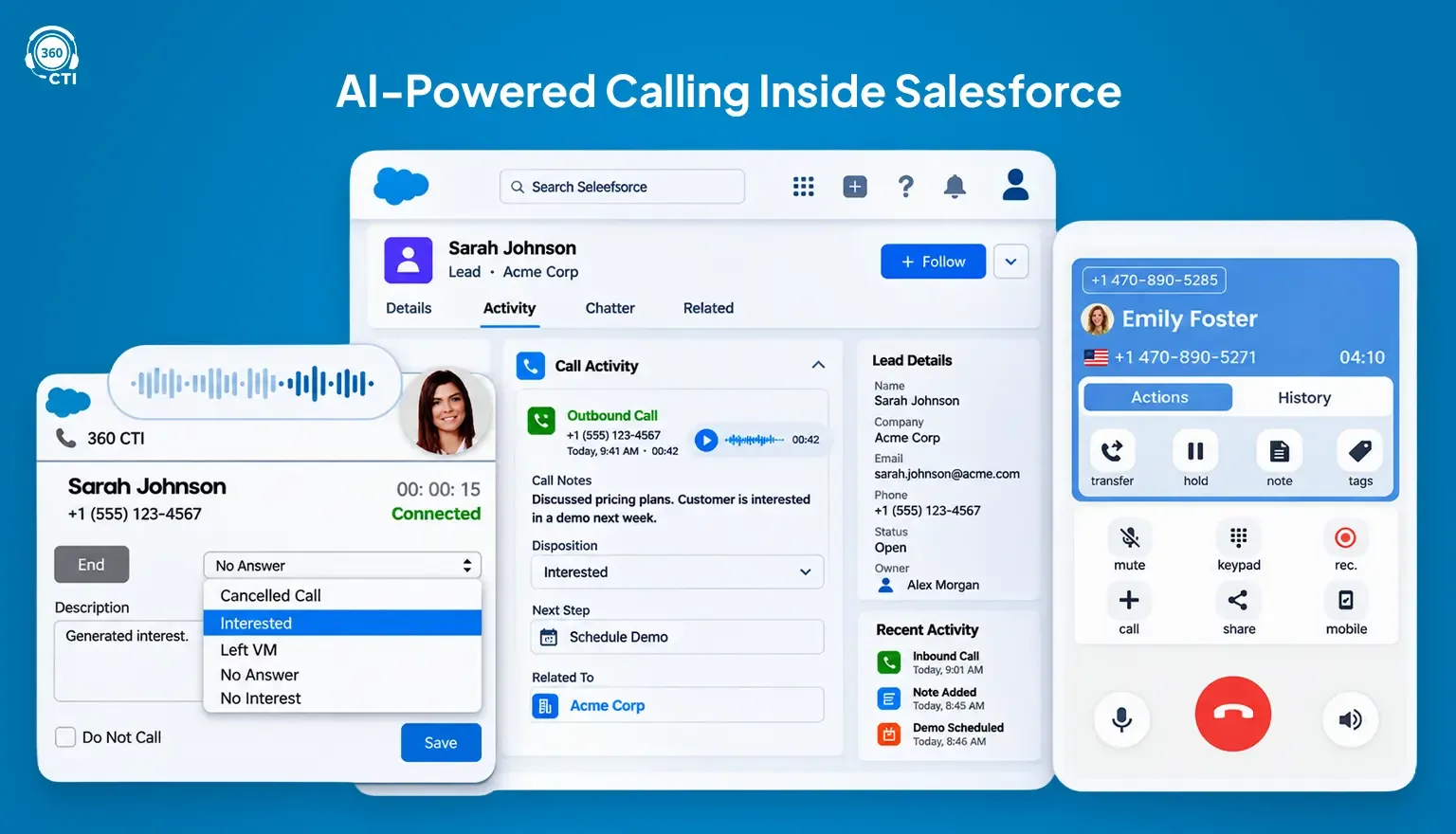
360 CTI is a native Salesforce Lightning application, meaning it's installed directly from the AppExchange and runs entirely inside your CRM without a browser extension or external app switching. That architecture is not common in this category and it has real workflow implications: call controls, activity logging, contact data, and AI outputs all live in the same window your reps are already working in.
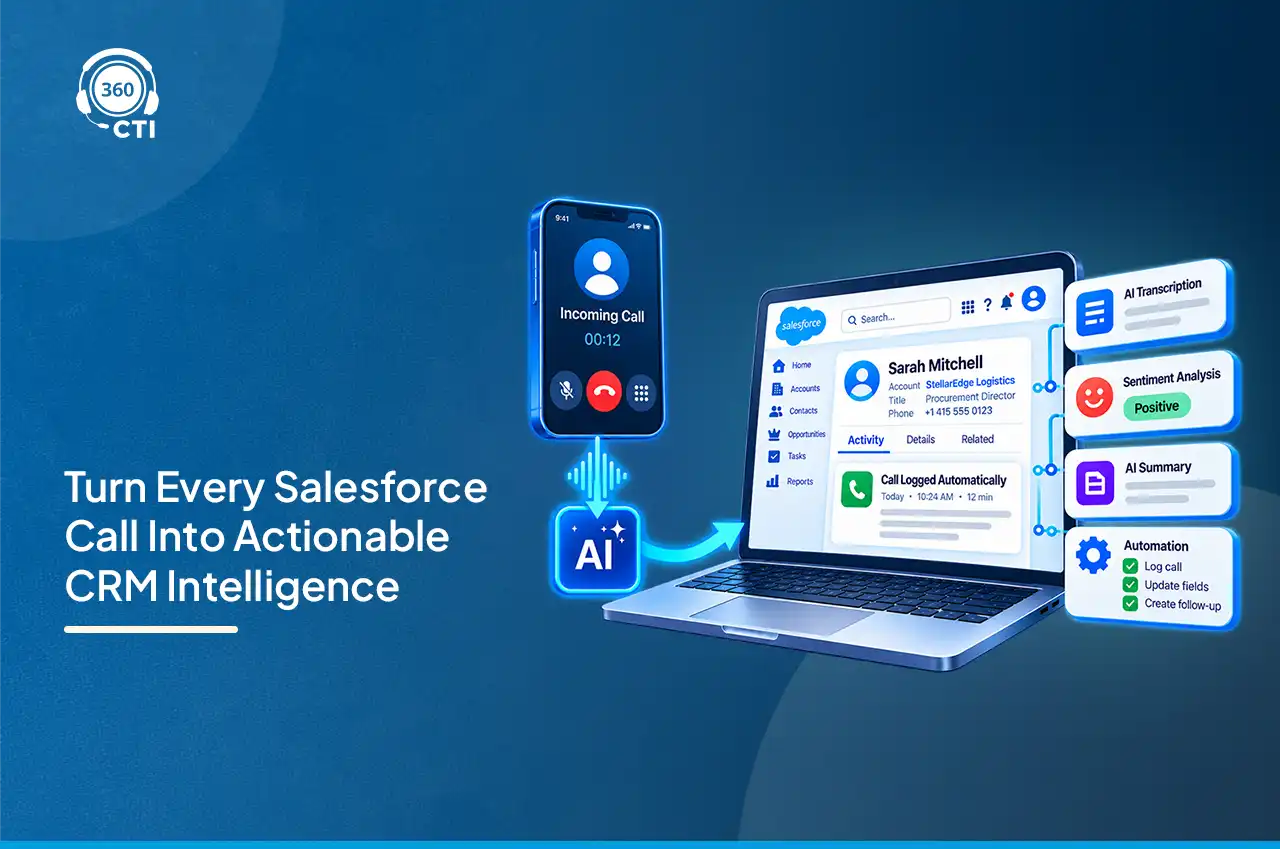
On the AI side, 360 CTI covers all four levels. Post-call, it auto-logs transcriptions with sentiment analysis and pushes summaries to activity records. During calls, the AI layer surfaces relevant context from the contact and account record. For prioritization, the Power Dialer, Auto Dialer, and Predictive Dialer let revenue ops teams configure automated calling workflows ranked by engagement signals. And for Level 4, the AI Voice Agent handles fully autonomous outbound calls for prospect qualification, appointment setting, and FAQ deflection.
Pricing starts at $15/user/month with no setup cost and nonprofit discounts available. The AppExchange rating sits at 4.88/5 from 90 reviews as of November 2026. Teams switching from standalone dialers typically cite compliance and CRM data quality as the two biggest improvements in the first 60 days. The platform is HIPAA, SOC 2 Type II, GDPR, and ISO certified, with Salesforce Shield support for teams with stricter data residency requirements. Channels supported: Voice, SMS, and WhatsApp.
Best for: Salesforce teams that want all four AI levels, native compliance, and no per-user data leaving the CRM
Want to see 360 CTI running inside your Salesforce org?
See the Power Dialer, AI transcription, and Voice Agent working from inside your CRM before you decide.
Book a Demo →2. Orum
Orum positions itself as an enterprise parallel dialer with an AI coaching layer on top. The parallel dialer dials up to 5 lines simultaneously, with the AI filtering out voicemails, busy signals, and dead numbers before connecting the rep to a live answer. The Salesfloor feature replicates the in-office calling environment virtually, letting managers coach reps live and reps hear each other's energy during a blitz session.
Salesforce integration is direct and confirmed as of November 2026 on the Orum website. AI operates at levels 1 through 3 — transcription, real-time coaching, and AI-ranked call lists. There's no published pricing; Orum requires a sales conversation for quotes and enforces a 9-seat minimum. The platform holds SOC 2 Type II, ISO 27001, and GDPR certifications.
Best for: Enterprise SDR teams running high-volume outbound with dedicated sales ops oversight
3. Nooks
Nooks takes the virtual salesfloor concept further than most, combining an AI parallel dialer with a shared digital workspace where the entire team dials together and managers can drop into any rep's session. The AI coaching layer includes live battlecard surfacing and objection handling scripts that appear in real time based on what the prospect says.
One thing worth noting on Salesforce integration: a direct native connector entered beta in mid-2026, but the primary production route as of November 2026 runs through sales engagement platforms like Outreach or Salesloft as an intermediary. Teams running Salesforce without one of those platforms in the stack should verify integration status directly before committing. Pricing is quote-based.
Best for: Teams already running Outreach or Salesloft alongside Salesforce who want an AI-powered parallel dialer
4. Aircall
Aircall starts at $30/user/month for the Essentials plan, but the Salesforce integration and Power Dialer both require the Professional tier at $50/user/month (annual, 3-seat minimum). AI Assist is bundled at Professional; the AI Assist Pro add-on runs an additional $49/user/month for expanded AI capabilities including call analysis and coaching feedback. With 250+ integrations and support across 100+ countries, Aircall is one of the more broadly deployed options on this list.
The AI operates at levels 1 and 2 — transcription with post-call summaries and real-time call scoring for rep feedback. There's no Level 3 or 4 capability on the current roadmap that's been publicly confirmed as of November 2026.
Best for: Teams needing broad integration coverage across multiple tools and geographies
5. Dialpad Sell
Dialpad Sell offers three published tiers: $39/user/month Essentials, $59/user/month Advanced, and $79/user/month Premium (all annual, from dialpad.com as of November 2026). The Power Dialer requires the Advanced tier and runs directly inside Salesforce, which is a meaningful differentiator compared to tools that open a separate window.
DialpadGPT is the company's proprietary AI coaching layer. It delivers real-time transcription, live call guidance, and post-call playback with AI-flagged moments. The AI operates at levels 1 and 2 with an emphasis on conversation intelligence over outbound volume management. For teams that have already committed to Dialpad as their business phone system, the Salesforce integration path is clean and well-documented.
Best for: Salesforce-native teams that want an in-CRM Power Dialer with strong real-time AI coaching
6. Kixie
Kixie offers a multi-line Power Dialer running up to 4 simultaneous lines, local presence spoofing through its ConnectionBoost feature, and AI Insights for post-call analysis. The platform has 865 reviews at 4.8/5 on G2 as of Q2 2026, which is one of the stronger review profiles in this category for mid-market buyers. Pricing is quote-based and not published on the kixie.com website as of November 2026.
Native Salesforce integration is listed as a confirmed feature. The AI operates primarily at levels 1 and 2: transcription, call summaries, and rep performance scoring. It's one of the more CRM-agnostic tools on this list, which makes it a reasonable choice for companies running multiple CRM platforms across different business units.
Best for: SMB and mid-market teams running multi-CRM environments who need a proven parallel dialer
7. JustCall
JustCall is one of the few tools in this category with fully transparent published pricing: $29/user/month Team, $49/user/month Pro, and $89/user/month Pro Plus (annual, 2-license minimum, from justcall.io as of August 2026). Salesforce CTI and the Power Dialer become available on the Pro tier. AI Review Assist, the company's automated call scoring and coaching tool, is included on Pro Plus.
For teams building their first calling setup inside Salesforce and working with a constrained budget, JustCall's pricing model eliminates the ambiguity that quote-based tools introduce into procurement. If you're trying to understand understanding which dialer mode fits your workflow before choosing a tier, that decision is worth making before you finalize which plan you need.
Best for: Teams that need predictable, published pricing and a clean Salesforce CTI without an enterprise sales process to get there
8. Revenue.io (formerly RingDNA)
Revenue.io was rebranded from RingDNA and positions itself as a revenue intelligence platform rather than a standalone dialer, though outbound dialing remains a core capability. The platform is Salesforce-native only — unlike most tools on this list, it doesn't support other CRMs, which is worth knowing going in. Moments™ is the company's real-time AI call guidance feature, surfacing talk tracks, competitor responses, and next-step recommendations during active conversations.
Pricing is custom and quote-based, with three named tiers: Activate, Engage, and Orchestrate. The platform is designed for larger enterprise deployments, typically 15 or more reps, with a dedicated implementation process. For companies at that scale where Salesforce is the only CRM and revenue intelligence is the primary buying requirement, Revenue.io is worth including in an evaluation.
Best for: Large enterprise sales organizations fully committed to Salesforce that need a full revenue intelligence platform, not just a dialer
AI Dialers for Salesforce: Side-by-Side Comparison
The columns that matter most when choosing an AI dialer for Salesforce are integration type, AI level, and whether pricing is public before you have to get on a sales call. Native vs. connector integration is a real workflow difference, not a marketing distinction, so that column deserves more weight than it usually gets. Power Dialer and AI Voice Agent are broken out separately because those two capabilities vary the most across this list and carry the biggest day-to-day impact on how your reps actually work.
| Tool | Salesforce Integration | AI Level | Power Dialer | AI Voice Agent | Starting Price |
|---|---|---|---|---|---|
| 360 CTI | Native Lightning app (AppExchange) | Levels 1–4 | Yes (Power, Auto, Predictive) | Yes | $15/user/month |
| Orum | Direct integration | Levels 1–3 | Yes (parallel, up to 5 lines) | No | Quote-based (9-seat minimum) |
| Nooks | Via Outreach or Salesloft (native connector in beta) | Levels 2–3 | Yes (AI parallel dialer) | Not stated | Quote-based |
| Aircall | Integration (Professional tier) | Levels 1–2 | Yes (Professional tier) | No | $30/user/month ($50 for Salesforce and Power Dialer) |
| Dialpad Sell | Salesforce integration, Power Dialer runs inside Salesforce | Levels 1–2 | Yes (Advanced tier) | No | $39/user/month ($59 for Power Dialer) |
| Kixie | Native integration listed (multi-CRM) | Levels 1–2 | Yes (up to 4 lines) | No | Quote-based |
| JustCall | Salesforce CTI (Pro tier) | Level 1 (AI Review Assist on Pro Plus) | Yes (Pro tier) | Not stated | $29/user/month ($49 for Salesforce and Power Dialer) |
| Revenue.io | Salesforce-native only | Level 2 (Moments™) | Outbound dialing is a core capability | Not stated | Custom quote |
📌 DID YOU KNOW
In February 2024, the FCC ruled that AI-generated voices in outbound calls constitute "artificial" voices under the Telephone Consumer Protection Act. That means any outbound call made by an AI voice agent to a US cell phone requires the same prior express written consent as a robocall. There's no B2B carve-out. If your team is evaluating Level 4 AI calling, your legal team needs to be part of that evaluation from day one.
Compliance Note: AI Calls and the TCPA
The practical implication of the FCC's February 2024 AI voice ruling is that prior express written consent is required before an AI voice agent can call a US cell phone, regardless of whether the call is commercial or informational. The standard "you may receive calls about your account" language in a web form doesn't cover it. You need explicit, documented consent that specifically covers AI-generated voice calls.
For outbound sales prospecting specifically, this creates a consent catch-22: you're trying to reach people who haven't consented to anything yet. The practical use case that survives this ruling is inbound callback (the prospect requested the call), re-engagement of existing customers who've given TCPA-compliant consent in writing, and lead qualification where the initial opt-in specifically covered AI voice outreach.
None of this makes AI voice agents unusable. It means the consent workflow has to be built correctly before you deploy. Any vendor selling you an AI Voice Agent without walking through TCPA consent requirements in the sales process is skipping a step that your legal team will eventually flag.
What to Actually Compare Before You Decide
The tools in this list cover a wide range of team sizes, budget bands, and AI maturity levels. What they share is that none of them are purely "AI dialers" or purely "power dialers" anymore the categories have blended significantly. The useful question isn't which tool has the most AI features; it's which AI level your team actually needs in the next 12 months and whether the Salesforce integration architecture matches how your reps spend their day.
For teams sorting through the dialer mode decision itself, understanding how the dialer modes compare side by side before shortlisting tools will save you a lot of redundant vendor demos. The compliance layer, particularly for teams considering AI Voice Agents, is worth getting legal sign-off on before the POC rather than after.