
📋 BLOG SUMMARY
Most AI voice agent deployments don’t fail because the technology is bad. They fail because nobody agreed on what “working” meant before the contract was signed. This post breaks down what AI voice agent ROI actually looks like in production, the four patterns that consistently drain budgets, and what teams seeing real results are doing differently inside Salesforce.
Most AI voice agent deployments don’t fail because the technology is bad. They struggle because nobody agreed on what success would look like before signing the contract.
I’ve spent more than a decade building Salesforce solutions and working with businesses trying to get more value from their technology investments. And if there’s one thing I’ve learned, it’s this: buying advanced technology is easy. Making it deliver measurable business value is where the real work begins.
That distinction has become even clearer as I’ve followed the conversations at Dreamforce, Agentforce World Tour, and across the Salesforce partner ecosystem. AI voice agents have moved from an exciting possibility to a serious business investment. But the questions leaders should be asking haven’t changed nearly enough.
How many customer problems will this actually solve? What will it cost to operate? And how will we know whether it’s working?
That’s what AI voice agent ROI should be about.
1. The Demo Was Never the Product
I was at Dreamforce 2025 when Salesforce unveiled Agentforce Voice. Within 90 days of launch, Agentforce had handled 380,000 customer service conversations. Pandora’s “Gemma” agent was maintaining context from web to phone call, so a customer who started on the website didn’t have to repeat themselves when they called in. The energy in that room was real.
But what interests me more than the demonstrations is what happens after those demonstrations end. A successful demo operates within controlled conditions. Production environments rarely offer that luxury.
Real customers have different accents, unpredictable questions, incomplete records, and expectations that don’t always fit predefined workflows.
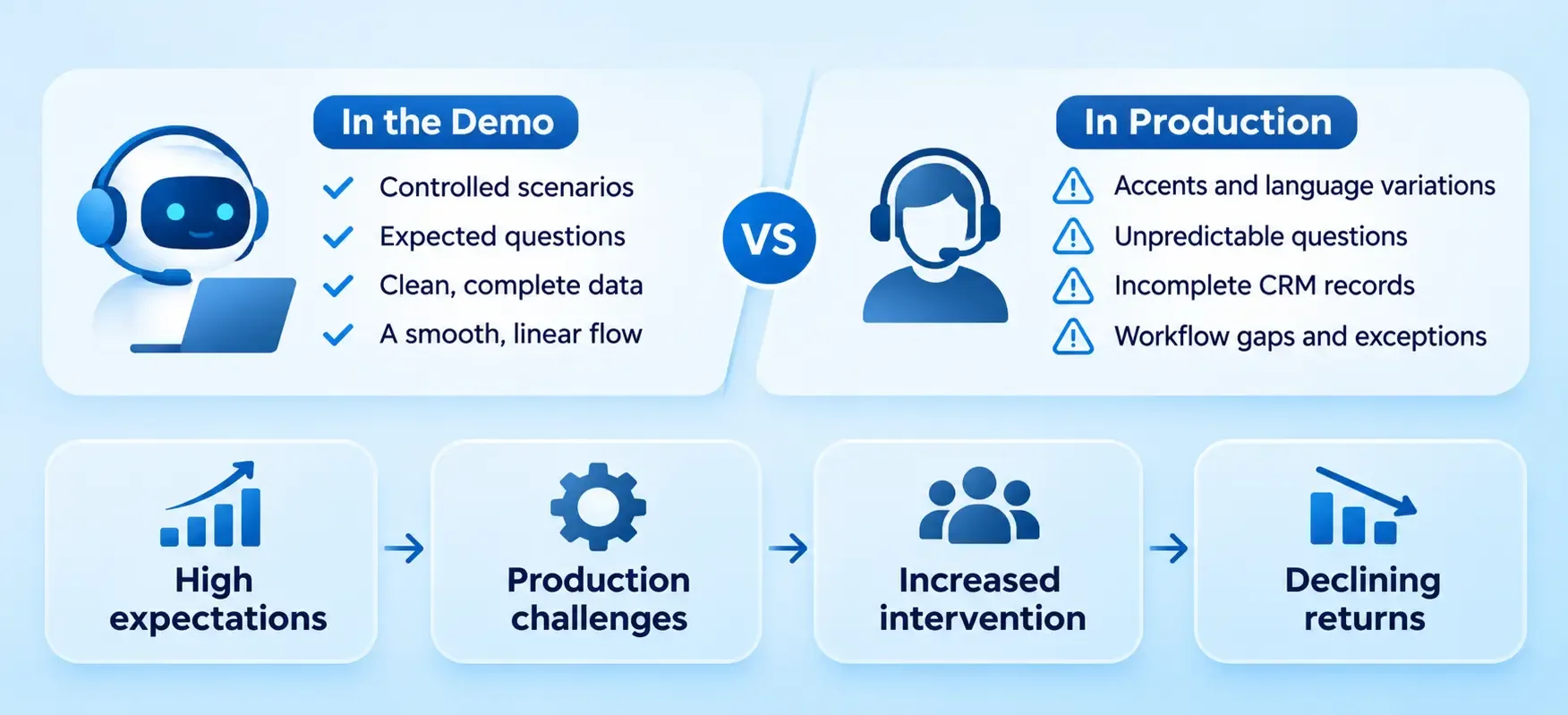
When businesses overlook these realities, a promising investment can quickly turn into an operational burden.
Here’s how that typically unfolds:
- High expectations: A business invests in AI voice based on impressive demo capabilities.
- Production challenges: Real conversations expose gaps in intent recognition, accuracy, and CRM integration.
- Increased intervention: Human agents spend more time correcting responses and handling escalations.
- Declining returns: Maintenance costs increase while the expected financial benefits remain out of reach.
This risk isn’t purely theoretical.
In its analysis of voice AI production failures, Coval illustrates how an undetected performance regression and inadequate evaluation infrastructure can result in an estimated financial impact exceeding $500,000.
What concerns me about situations like this isn’t necessarily the AI’s inability to perform. It’s the organization’s inability to recognize when performance starts deteriorating.
Businesses need to approach AI voice as an operational capability that requires continuous evaluation, not simply another software implementation.
Trying to build a business case for AI voice inside Salesforce?
Our team helps Salesforce contact centers scope AI voice deployments that map to real call volume and CRM data.
Talk to an Expert →2. What “AI Voice Agent ROI” Actually Means
AI voice agent ROI measures the financial value generated through automated customer conversations against the total cost of implementing, operating, and maintaining the technology.
However, the number you’ll frequently encounter in AI voice pitches is containment rate: the percentage of calls handled without transferring them to a human agent.
Containment is useful, but it’s not necessarily resolution.
An AI agent can end a call without solving the customer’s problem. It can provide incomplete information without escalating the conversation. Both interactions might appear successful in a containment report.
Neither necessarily creates business value.
Which metrics should businesses track beyond containment?
| Metric | What It Reveals |
|---|---|
| Cost per resolved interaction | Whether AI is genuinely reducing service costs |
| First contact resolution | Whether customer problems are resolved without additional contact |
| Customer satisfaction (CSAT) | Whether automation is improving or compromising customer experience |
| Human escalation rate | Which conversations still require human intervention |
| Repeat contact rate | Whether apparent resolutions are actually effective |
| Time to payback | How long it takes to recover the AI investment |
I would pay particular attention to cost per resolved interaction. If customers repeatedly contact your business because their original inquiry wasn’t resolved, a seemingly inexpensive AI interaction can become an expensive customer journey.
How do you calculate AI voice agent ROI?
Businesses can calculate AI voice agent ROI using the following formula:
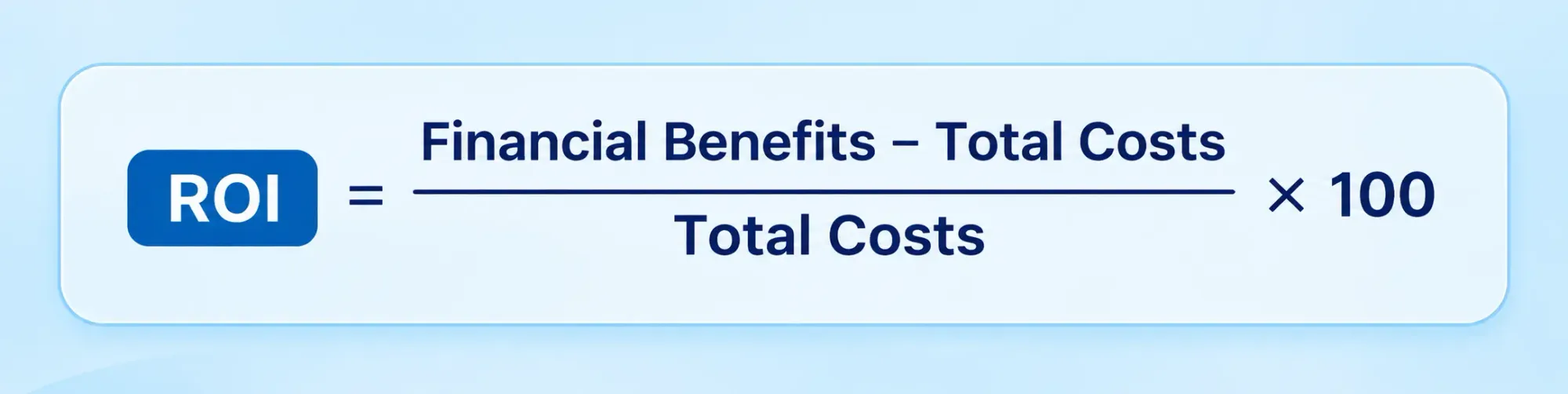
The challenge isn’t calculating the percentage. It’s identifying which benefits and expenses belong in the calculation.
| Financial Benefits | Investment and Operating Costs |
|---|---|
| Reduced call handling costs | AI licensing and usage charges |
| Lower administrative workloads | Telephony infrastructure |
| Avoided additional hiring costs | Salesforce integration and configuration |
| Attributable revenue opportunities | Testing, monitoring, and maintenance |
3. Where AI Voice Investments Live or Die Inside Salesforce
This is the conversation most AI voice vendors skip entirely because they’re not telephony companies. But it’s the most important one.
Your AI voice agent is only as useful as the data it can access and the records it can update. If the telephony layer doesn’t expose the right Salesforce fields, doesn’t pass call context properly, or logs calls to incomplete records, the AI is operating blind. It can’t personalize based on account history, pull up case status in real time, or route intelligently based on agent availability and skill.
Over the years, my team and I have worked on Salesforce implementations where the biggest challenge wasn’t a lack of technology. It was that the existing systems, processes, and customer information weren’t connected well enough.
That experience shapes how I look at AI today.
You cannot build intelligent customer conversations on top of disconnected business processes and expect consistent results.
It’s also why we’ve invested in Salesforce connected calling capabilities through 360 CTI.
Our Salesforce AI Voice Agent is designed to handle customer conversations, identify intent, capture outcomes, and escalate calls to human representatives when necessary.
And our AI powered call routing capabilities help connect customers with the appropriate resources based on available context and routing rules.
But I don’t believe every company should rush to deploy AI voice agents simply because the technology is available.
Before making that investment, I’d first examine whether the existing Salesforce environment, telephony infrastructure, and customer workflows are ready to support it.
Because if those foundations aren’t right, AI may expose operational inefficiencies rather than eliminate them.
4.The four Patterns That Consistently Drain AI Voice Budgets
After watching a range of these deployments, the failures cluster around four patterns.
Skipping intent mapping. The AI is deployed before anyone has catalogued what callers actually ask for. Without this groundwork, the system can’t distinguish high volume routine intents (which AI handles well) from complex judgment calls (which it shouldn’t handle alone). The result is an AI that escalates everything and resolves nothing.
Treating deployment as a one time project. Voice AI degrades when your products, policies, or customer base change and the AI’s knowledge base doesn’t. Teams seeing sustained results treat AI voice maintenance like a CRM admin function: someone owns it, monitors it, and updates it continuously.
Measuring success too early. The first 30 days of an AI voice deployment are not representative. Call flows, voice design, intent tuning, and customer behavior all need time to stabilize. Teams that pull the plug at day 45 because containment is low often abandon a deployment that would have worked by month three.
Ignoring the handoff. When an AI voice agent escalates to a human, that transition should be invisible. The human agent needs to see a full transcript, case summary, and customer context immediately inside the right Salesforce record. If your call routing setup doesn’t deliver that context cleanly, the customer experience breaks at exactly the moment the AI’s value would have been proven.
Planning an AI voice deployment or evaluating your current telephony setup?
Our checklist covers the integration requirements, Salesforce org readiness checks, and rollout sequencing.
Download the Checklist →5. What Real AI Voice Agent ROI Looks Like at Scale
Salesforce’s own internal Agentforce deployment handled 3 million support conversations in just over a year, contributing to $100 million in annualized cost savings and a year over year drop of more than 170,000 cases despite customer growth. That’s what a mature, well integrated deployment looks like.
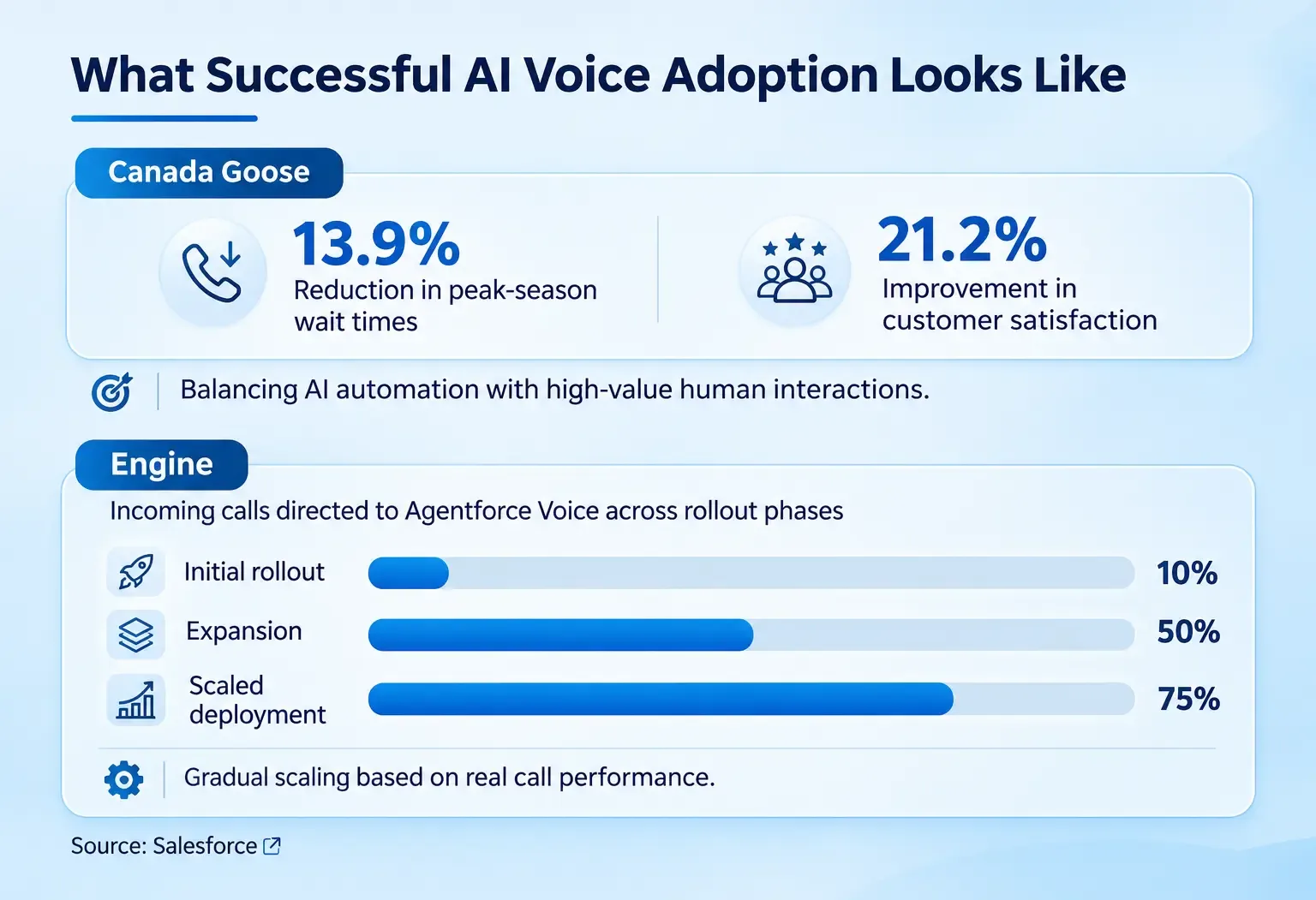
At Dreamforce 2026, the customer stories shared on stage shared a common thread. Southwest Airlines uses real chat data to shape where it deploys AI next. Actual customer questions, not internal assumptions, drive prioritization. Canada Goose discovered what customers wanted by asking them, and kept asking as the deployment scaled. Neither team tried to solve everything on day one.
AI voice agent cost justification at the CFO level comes down to three questions: What does it cost per resolved call today? What will it cost with AI handling a defined set of call types? How long does it realistically take to get there?
The organizations seeing real contact center AI ROI can answer all three before they sign a contract. If your vendor can’t answer the third question cleanly, that’s the conversation you need to push for before anything else.
Conclusion
So, is AI voice agent worth it? After more than a decade in the Salesforce ecosystem, I’ve learned that technology alone doesn’t create business value. Execution does.
From Dreamforce to Agentforce World Tour, one thing is becoming clear: successful AI adoption isn’t about deploying more agents. It’s about solving real customer problems and delivering measurable outcomes.
That’s why I believe businesses must prioritize connected data, reliable workflows, and clear ROI expectations before investing in AI voice.
Before asking how many calls an AI voice agent can handle, ask how many customer problems it can solve.